


ZWO ASI678MC In-Depth Review – One of the Finest Colour Planetary Cameras Available
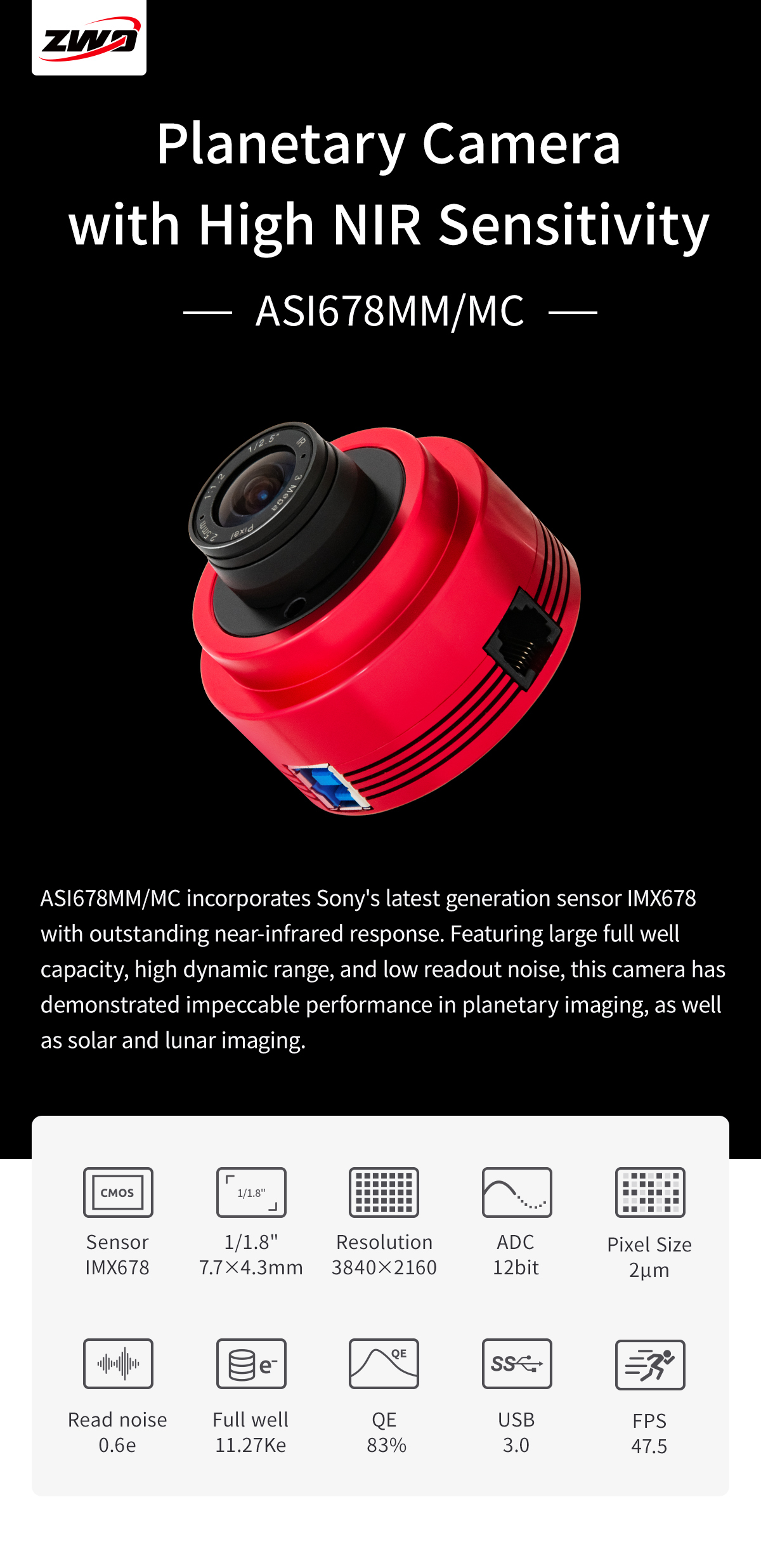
The ZWO ASI678MC has rapidly established itself as one of the most capable colour planetary cameras available today. Built around Sony's advanced STARVIS 2 IMX678 CMOS sensor, it combines exceptionally low read noise, remarkable near-infrared sensitivity and extremely small 2μm pixels to deliver outstanding planetary, lunar and solar performance.
Unlike larger cooled astronomy cameras designed primarily for deep-sky imaging, the ASI678MC has been developed for capturing extremely fine detail on rapidly changing objects such as Jupiter, Saturn and Mars. Its fast USB 3.0 interface allows thousands of images to be captured in only a few minutes before specialist stacking software combines the sharpest frames into one highly detailed final photograph.
For many planetary imagers, the camera's biggest advantage is its outstanding Sony STARVIS 2 sensor. This latest generation CMOS technology improves both sensitivity and dynamic range while significantly increasing performance in the near-infrared spectrum. The result is cleaner images, sharper planetary detail and excellent performance even under average atmospheric conditions.
Whether you're taking your first steps into planetary astrophotography or upgrading from an older CMOS camera, the ASI678MC offers exceptional image quality, outstanding value and a level of performance that rivals considerably more expensive cameras.
Dark Clear Skies Verdict
Overall Rating: 9.8 / 10
| Planetary Imaging | ★★★★★ 10/10 |
| Lunar Imaging | ★★★★★ 10/10 |
| Solar Imaging | ★★★★★ 10/10 |
| Infrared Imaging | ★★★★★ 10/10 |
| Deep Sky | ★★★☆☆ 6.5/10 |
| Value for Money | ★★★★★ 10/10 |
| Overall | 9.8 / 10 |
The ASI678MC isn't designed to do everything—and that's exactly why it's so good. If your goal is producing stunning images of Jupiter, Saturn, Mars, the Moon or the Sun, very few colour astronomy cameras currently offer better performance for the money.
Key Features
- Sony STARVIS 2 IMX678 colour CMOS sensor
- 3840 × 2160 (8.3 Megapixel) resolution
- Ultra-small 2μm pixels for exceptional planetary detail
- Outstanding near-infrared sensitivity
- Extremely low read noise
- High-speed USB 3.0 interface
- 47.5fps at full resolution
- Excellent quantum efficiency
- 256MB DDR3 image buffer
- ST4 autoguider port
- Compatible with Windows, macOS and Linux
- Supports ASIStudio, FireCapture, SharpCap and many third-party applications
Why the ASI678MC Has Become So Popular
The ASI678MC arrived at exactly the right time. Modern telescopes are becoming optically better, atmospheric correction techniques continue to improve and stacking software has never been more powerful. What imagers needed was a sensor capable of extracting every last detail from those improvements.
The Sony IMX678 delivers exactly that. Its tiny 2μm pixels allow exceptional sampling when used with common planetary telescopes, while STARVIS 2 technology dramatically improves sensitivity compared with older CMOS designs.
Perhaps the biggest surprise is its near-infrared performance. Many experienced planetary imagers spend much of their time capturing infrared data because longer wavelengths are less affected by poor atmospheric seeing. The IMX678 excels in this area, making it one of the most desirable sensors currently available for serious planetary imaging.
Rather than attempting to be an all-purpose astronomy camera, the ASI678MC focuses on doing one job exceptionally well—and that focus is exactly what makes it such a superb performer.
Sony STARVIS 2 IMX678 Sensor
At the heart of the ASI678MC is Sony's latest-generation STARVIS 2 IMX678 back-illuminated CMOS sensor. Although its specifications look impressive on paper, it's the way those specifications translate into real-world planetary imaging that makes this camera stand out.
The IMX678 combines an 8.3 megapixel resolution with extremely small 2μm pixels, exceptionally low read noise and outstanding quantum efficiency. The sensor has also been engineered to provide dramatically improved sensitivity in the near-infrared region, making it particularly attractive for planetary imagers who regularly use IR-pass filters.
Unlike older CMOS sensors that often forced users to choose between sensitivity and resolution, the IMX678 manages to deliver both. Fine planetary detail can be recorded while maintaining excellent signal quality, even during relatively short exposures.
Whether you're capturing the cloud belts of Jupiter, Saturn's delicate ring structure or the tiny polar cap on Mars, the sensor is capable of extracting remarkable levels of detail when paired with good optics and steady atmospheric conditions.

Why 2μm Pixels Are Actually an Advantage
One of the first specifications people notice is the tiny 2μm pixel size. Beginners often assume that smaller pixels automatically mean poorer image quality, but planetary imaging works very differently from deep-sky astrophotography.
When photographing planets, the goal is to resolve the smallest possible surface details. Smaller pixels allow the telescope to sample those fine details more accurately, particularly when working at the high focal ratios commonly used for planetary imaging.
For example, a Schmidt-Cassegrain telescope combined with a quality Barlow lens often operates between f/15 and f/25. At these focal ratios, the 2μm pixels of the ASI678MC provide exceptionally fine image sampling without requiring excessive magnification.
The result is sharper planetary images with improved detail across cloud belts, storms, ring structures and surface markings. Combined with modern stacking software, these tiny pixels allow the camera to produce images that would have been difficult to achieve only a few years ago.
Rather than being a disadvantage, the compact pixel size is one of the camera's greatest strengths.
Perfect Partners for Schmidt-Cassegrain Telescopes
The ASI678MC feels almost purpose-built for Schmidt-Cassegrain telescopes.
Popular instruments such as the Celestron C8, C9.25, C11 and C14 naturally provide the long focal lengths needed for high-resolution planetary work. Add a quality 2x or 2.5x Barlow lens and the camera reaches an image scale capable of revealing astonishing detail during steady seeing conditions.
The same applies to Maksutov-Cassegrain telescopes, which have long been favourites among planetary observers thanks to their sharp optics and naturally long focal lengths.
Owners of Newtonian reflectors can also achieve outstanding results by using an appropriate Barlow lens to increase the effective focal ratio. The camera's flexibility means it works well across almost every popular planetary telescope design.

Near-Infrared Performance
One of the defining characteristics of the IMX678 sensor is its outstanding response beyond the visible spectrum.
Many experienced planetary imagers spend much of their imaging time working in the near-infrared using filters such as IR685, IR742 and IR850. These longer wavelengths are affected less by atmospheric turbulence, often producing noticeably sharper images when seeing conditions are average rather than exceptional.
The IMX678's improved infrared sensitivity means exposure times remain short enough to capture thousands of frames quickly while still maintaining excellent signal levels. This allows stacking software to produce cleaner final images with increased detail.
For Jupiter and Saturn, infrared imaging often reveals finer atmospheric structure than colour imaging alone. Mars also benefits enormously, with subtle surface markings becoming much easier to record during favourable oppositions.
For this reason alone, many planetary imagers regard the IMX678 as one of the finest colour sensors currently available.
High-Speed Image Capture
Planetary imaging depends on speed. Unlike deep-sky photography, where individual exposures may last several minutes, planetary imaging captures thousands of very short exposures over a period of only a few minutes.
The ASI678MC achieves up to 47.5 frames per second at full sensor resolution, with considerably higher frame rates possible when using a smaller Region of Interest (ROI).
This allows imagers to record huge quantities of data during the brief moments of stable atmospheric seeing that often determine whether an image becomes good or exceptional.
When combined with software such as FireCapture and AutoStakkert!, the high frame rate becomes one of the camera's greatest strengths.
Read Noise and Dynamic Range
Although planetary imaging usually involves very short exposures, low read noise still plays an important role. Every frame captured contains a small amount of electronic noise generated by the camera itself. Lower read noise means more useful image information is retained within every individual frame.
After stacking thousands of exposures together, this produces smoother images with cleaner backgrounds and greater contrast, making delicate planetary features easier to enhance during processing.
The excellent dynamic range of the IMX678 also helps preserve subtle tonal transitions across planetary discs, preventing bright regions from saturating while maintaining detail within darker areas.
Planetary Performance in the Real World
The ASI678MC has earned an excellent reputation amongst planetary imagers because it performs consistently across every major Solar System target. Whether you're photographing Jupiter's constantly changing cloud belts, Saturn's ring system or the shrinking polar cap on Mars, the camera delivers an exceptional combination of sharpness, sensitivity and frame rate.
During planetary imaging sessions, atmospheric turbulence is usually the biggest limiting factor rather than the camera itself. The ASI678MC's high-speed USB 3.0 interface allows thousands of frames to be recorded in just a few minutes, dramatically increasing the chances of capturing those brief moments when the atmosphere becomes perfectly steady.
Once stacked using software such as AutoStakkert! and sharpened in RegiStax or AstroSurface, the resulting images often reveal an astonishing amount of fine detail that would never be visible in a single exposure.
The camera's low read noise also allows higher gain settings to be used without introducing excessive electronic noise, helping maintain fast exposure times even when using infrared filters or high focal ratios.
Jupiter Imaging
Jupiter is often regarded as the ultimate test of a planetary camera. Its constantly changing atmosphere, rapidly rotating surface and subtle cloud structures demand high frame rates and excellent sensitivity.
The ASI678MC is superbly suited to the task.
Fine detail within the North and South Equatorial Belts, delicate festoons, small white ovals and even the turbulent wake behind the Great Red Spot can all be recorded under favourable seeing conditions. Combined with a quality Schmidt-Cassegrain telescope and atmospheric dispersion corrector (ADC), the camera is capable of producing images that rival those taken with considerably more expensive equipment.
Saturn Imaging
Saturn presents a different challenge. Although physically larger than Mars, its greater distance means the planet appears much smaller in the sky. High image scale and excellent sensitivity therefore become essential.
The ASI678MC's tiny 2μm pixels allow extremely fine sampling without requiring excessively powerful Barlow lenses. This helps reveal subtle detail within Saturn's cloud bands while maintaining excellent definition across the famous ring system.
During steady conditions, features such as the Cassini Division, ring shading and atmospheric banding become beautifully defined.
Mars Imaging
Mars rewards resolution like no other planet. During favourable oppositions, surface markings only a few hundred kilometres across become visible through amateur telescopes.
The IMX678 sensor excels here. Its excellent infrared response allows imagers to record remarkable surface detail using IR-pass filters, often producing sharper results than colour imaging when atmospheric seeing is average.
Dark volcanic plains, bright deserts, cloud formations and shrinking polar caps all become accessible to experienced imagers using telescopes in the 8-inch to 14-inch class.
Lunar Imaging
The Moon is perhaps where the ASI678MC really surprises people.
Its combination of high resolution, small pixels and fast frame rates makes it capable of producing incredibly detailed close-up images of the lunar surface. Craters, mountain ranges, lava flows and delicate rilles can all be recorded with exceptional clarity.
The compact sensor is also ideal for creating high-resolution mosaics. Multiple overlapping panels can be captured quickly before being stitched together into enormous detailed lunar landscapes.
For owners of larger Schmidt-Cassegrain or Maksutov telescopes, the ASI678MC is one of the finest lunar imaging cameras currently available.
Solar Imaging
When used with the correct front-mounted white-light filter or a dedicated Hydrogen-Alpha solar telescope, the ASI678MC becomes a superb solar imaging camera.
The high frame rates allow atmospheric turbulence to be frozen, while the sensor's excellent sensitivity records intricate solar detail including granulation, sunspots, filaments and prominences.
The small pixel size is particularly beneficial when imaging through longer focal length solar telescopes, allowing extremely fine surface detail to be resolved.
Never observe or photograph the Sun without an approved solar filter securely fitted to the front of your telescope.
Electronically Assisted Astronomy (EAA)
Although designed primarily for planetary imaging, the ASI678MC is also capable of producing enjoyable Electronically Assisted Astronomy sessions.
Its sensitive STARVIS 2 sensor allows bright nebulae, globular clusters and galaxies to build rapidly on-screen using live stacking software such as SharpCap.
While the smaller sensor naturally provides a narrower field of view than larger deep-sky cameras, many observers appreciate the increased image scale when observing smaller galaxies and planetary nebulae.
For astronomers who enjoy both planetary imaging and occasional live deep-sky observing, the ASI678MC offers far more versatility than many people expect.
Who Should Buy the ASI678MC?
We believe the ASI678MC is an excellent choice for:
- Planetary imagers looking for maximum detail.
- Lunar photographers.
- Solar observers using dedicated solar telescopes.
- Owners of Schmidt-Cassegrain telescopes.
- Maksutov-Cassegrain users.
- Dobsonian owners using tracking platforms.
- Astronomers upgrading from older USB2 planetary cameras.
- Anyone wanting one of the very best colour planetary cameras currently available.
Who Should Consider Another Camera?
- If your primary interest is wide-field deep-sky imaging, an APS-C camera such as the ASI2600MC Pro will provide a much larger field of view.
- If you intend to build a monochrome LRGB or narrowband imaging system, a mono camera will offer greater flexibility.
- If your main interest is very large nebulae, larger sensors will be a better long-term investment.
ASI678MC vs ASI585MC Pro
Although both cameras use Sony's latest STARVIS 2 technology, they are designed for different types of astrophotography.
The ASI678MC is a specialist planetary camera. Its ultra-small 2μm pixels, outstanding near-infrared sensitivity and fast frame rates make it one of the finest colour cameras currently available for imaging Jupiter, Saturn, Mars and the Moon.
The ASI585MC Pro is a far more versatile camera. While still excellent for planetary imaging, its larger sensor, integrated cooling and wider field of view make it much more suitable for long-exposure deep-sky astrophotography.
If your primary goal is producing the highest possible planetary images, we would choose the ASI678MC. If you want one camera capable of both planetary and deep-sky imaging, the ASI585MC Pro is the stronger all-round performer.
| Feature | ASI678MC | ASI585MC Pro |
|---|---|---|
| Planetary Imaging | ★★★★★ | ★★★★★ |
| Lunar Imaging | ★★★★★ | ★★★★★ |
| Solar Imaging | ★★★★★ | ★★★★★ |
| Deep Sky | ★★★☆☆ | ★★★★★ |
| Infrared Imaging | ★★★★★ | ★★★★☆ |
| Overall Versatility | ★★★★☆ | ★★★★★ |
ASI678MC vs ASI662MC
The ASI662MC remains an excellent planetary camera and continues to be a popular choice for beginners. However, the ASI678MC benefits from Sony's newer IMX678 STARVIS 2 sensor, offering higher resolution, improved quantum efficiency and significantly better near-infrared performance.
If your budget allows, the ASI678MC is the camera we would recommend for anyone wanting the best possible colour planetary performance from a modern CMOS sensor.
Recommended Accessories
To get the very best from the ASI678MC, we recommend pairing it with high-quality accessories that complement its strengths.
- 2x or 2.5x Premium Barlow Lens
- Atmospheric Dispersion Corrector (ADC)
- Motorised Electronic Focuser
- IR685, IR742 or IR850 Infrared Filters
- UV/IR Cut Filter for Colour Imaging
- High-Speed USB 3.0 Cable
- Stable Equatorial or Alt-Azimuth Tracking Mount
Pros
- Outstanding Sony STARVIS 2 sensor.
- Excellent value for money.
- Exceptional planetary performance.
- Industry-leading infrared sensitivity.
- Tiny 2μm pixels provide excellent image sampling.
- Fast USB 3.0 performance.
- Very low read noise.
- High quantum efficiency.
- Excellent lunar and solar imaging.
- Compact, lightweight and easy to use.
Considerations
- Designed primarily for planetary imaging.
- Smaller field of view than APS-C astronomy cameras.
- Cooling is not included.
- Not intended to replace dedicated cooled deep-sky cameras.
Frequently Asked Questions
Is the ASI678MC good for beginners?
Yes. It is one of the easiest high-performance planetary cameras to recommend. Beginners will appreciate its straightforward setup, while experienced imagers will enjoy its outstanding performance.
Can I image Jupiter with the ASI678MC?
Absolutely. Jupiter is one of the camera's strongest subjects. Its fast frame rates and excellent sensitivity allow remarkable detail to be captured.
Can I image Saturn?
Yes. The tiny pixels make the ASI678MC particularly well suited to Saturn when used with longer focal length telescopes.
Can I image Mars?
Yes. Mars is one of the best targets for the IMX678 sensor, especially when infrared-pass filters are used during favourable oppositions.
Can I photograph the Moon?
Yes. The camera produces superb high-resolution lunar images and is ideal for creating detailed lunar mosaics.
Can I photograph the Sun?
Yes, but only when used with an approved solar filter or dedicated solar telescope.
Is the ASI678MC suitable for deep-sky imaging?
It can be used for Electronically Assisted Astronomy and some deep-sky targets, but it is primarily designed as a planetary camera. For dedicated deep-sky imaging, a cooled camera such as the ASI533MC Pro or ASI2600MC Pro will generally be a better choice.
Does it work with ASIAIR?
Yes. The ASI678MC is fully compatible with the ZWO ASIAIR ecosystem.
Which telescope works best?
Schmidt-Cassegrain, Maksutov-Cassegrain and long focal length Newtonian telescopes all pair exceptionally well with the ASI678MC.
Is it worth upgrading from an older planetary camera?
If you're using an older USB2 or first-generation CMOS planetary camera, the improvements in sensitivity, resolution and infrared performance are significant.
Dark Clear Skies Final Verdict
The ZWO ASI678MC is one of the finest colour planetary cameras currently available. Rather than trying to be an all-purpose astronomy camera, it focuses on delivering outstanding performance where it matters most—capturing incredible detail on the Solar System's brightest objects.
The Sony IMX678 STARVIS 2 sensor combines excellent sensitivity, ultra-low read noise, impressive quantum efficiency and class-leading near-infrared performance to produce images that continue to impress both beginners and experienced planetary imagers alike.
If your passion is photographing Jupiter's cloud belts, Saturn's rings, the rugged lunar surface or intricate solar detail, the ASI678MC deserves a place at the very top of your shortlist. It delivers premium performance, excellent value for money and represents one of the strongest investments currently available for high-resolution planetary astrophotography.
Need Help Choosing the Right Planetary Camera?
Choosing between the ASI678MC, ASI585MC Pro, ASI662MC and other ZWO cameras depends on your telescope, focal length and imaging goals.
If you're unsure which camera is the best match for your equipment, we're always happy to help.