Skip to content
Skip to product information
Description

ZWO ASI2600MC Air Review – All-in-One Deep Sky Imaging Camera

The ZWO ASI2600MC Air is one of the most important astrophotography cameras ZWO has released in recent years. It combines a premium APS-C cooled colour imaging camera, built-in guide camera, ASIAIR smart control, Wi-Fi, storage, USB hub and 12V power distribution into one compact unit.

For many astrophotographers, the biggest challenge is no longer simply choosing a good sensor. It is building a reliable imaging system that is easy to set up, easy to power, easy to control and not buried under a mess of cables. The ASI2600MC Air directly addresses that problem.

At the centre of the camera is the excellent Sony IMX571 APS-C sensor, already well known from the popular ASI2600MC Pro. What makes the Air version different is the level of integration. Instead of needing a separate ASIAIR, guide camera, USB hub and power distribution system, much of that functionality is built into the camera body itself.

This makes the ASI2600MC Air especially attractive for portable astrophotography, ZWO AM3 and AM5 users, refractor-based imaging rigs, and anyone who wants a cleaner, simpler route into serious deep-sky imaging.

Dark Clear Skies Verdict

Overall rating: 9.8/10

The ZWO ASI2600MC Air is a superb choice for astrophotographers who want premium APS-C image quality with a much simpler setup. The proven IMX571 sensor delivers excellent deep-sky performance, while the built-in guide camera, ASIAIR control, storage and power management make the whole imaging rig cleaner and easier to manage.

Best for: deep-sky imaging, portable setups, ZWO AM3/AM5 users, advanced beginners, refractor owners and anyone wanting a highly integrated astrophotography system.

Key Features

  • 26MP Sony IMX571 APS-C colour sensor
  • 6248 x 4176 resolution
  • 3.76µm pixel size
  • Built-in SC2210 guide sensor from the ASI220MM Mini
  • Integrated ASIAIR smart control
  • 256GB internal eMMC storage
  • Dual-band 2.4G / 5G Wi-Fi
  • 4 x USB 2.0 ports
  • 3 x 12V DC power ports
  • USB-C connection for fast file transfer
  • Two-stage TEC cooling
  • IR-cut protective window for colour imaging
  • Supports ASIAIR App, ASI Studio and Alpaca-compatible third-party software
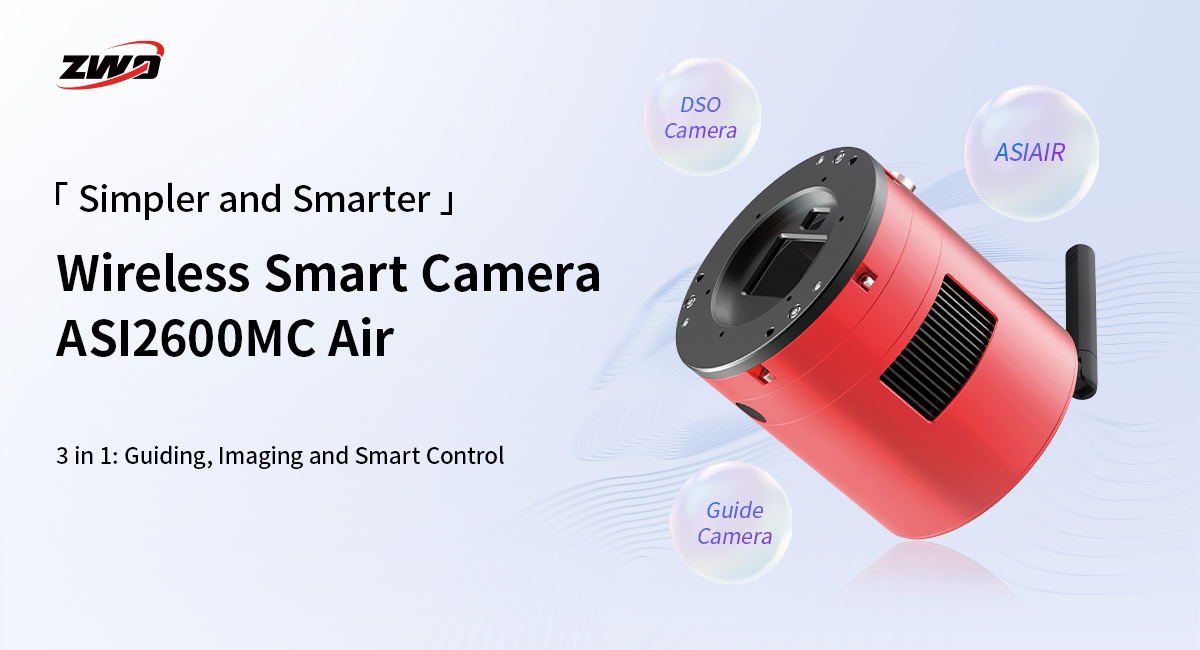
ZWO ASI2600MC Air astrophotography camera overview

Why the ASI2600MC Air is Different

The ASI2600MC Air is not just another cooled colour camera. It is closer to a complete astrophotography control centre built around a premium imaging sensor.

A traditional deep-sky setup often needs a main camera, guide camera, guide scope or off-axis guider, ASIAIR or mini PC, USB hub, power distribution unit and multiple cables running between everything. That works well, but it can be fiddly, especially in the dark or when imaging away from home.

The ASI2600MC Air reduces that complexity. With the guide camera, smart controller, storage, USB connectivity and power outputs built in, the system becomes much neater. There are fewer points of failure and fewer cables to catch, pull loose or route around the mount.

For portable imagers, this is a major advantage. It means faster setup, faster pack-down and less time troubleshooting equipment when you should be collecting photons.

Sony IMX571 APS-C Sensor

The main imaging sensor is Sony's highly regarded IMX571, a 26MP APS-C back-illuminated CMOS sensor. This sensor has become one of the most trusted choices in modern amateur astrophotography because it offers an excellent balance of field of view, resolution, sensitivity and low noise.

The APS-C format is large enough to capture wide nebulae, galaxy groups and star fields, while still being manageable for many modern refractors and corrected telescopes. With a sensor size of 23.5mm x 15.7mm and a 28.3mm diagonal, it pairs particularly well with telescopes that provide a well-corrected APS-C image circle.

The 3.76µm pixels are also a very useful size. They work well with short to medium focal length refractors and provide a sensible image scale for typical UK seeing conditions. This makes the ASI2600MC Air a very versatile camera rather than something suited to only one type of telescope.
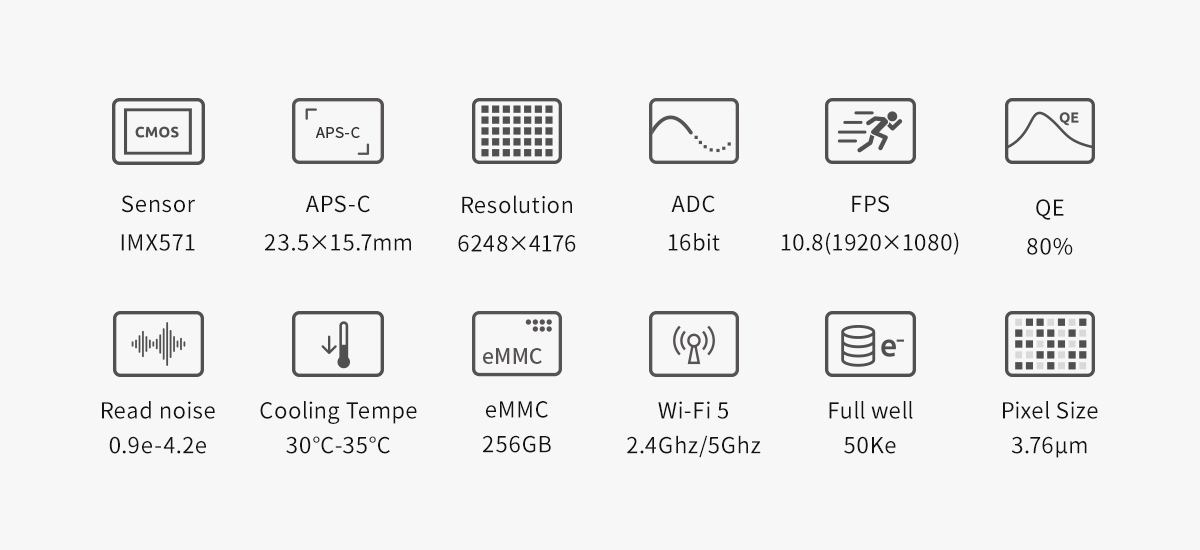
ZWO ASI2600MC Air IMX571 APS-C sensor details

Built-In Guide Camera

One of the most useful features of the ASI2600MC Air is the integrated guide sensor. ZWO uses the SC2210 sensor, the same sensor family used in the ASI220MM Mini guide camera.

This sensor is highly sensitive, with a quoted QE peak of 92% at 500nm and very low read noise. In practical terms, that means it is well suited to finding guide stars and maintaining accurate tracking during long-exposure imaging.

For many refractor-based setups, the built-in guide camera can remove the need for a separate guide camera and additional cabling. This is especially useful when building a clean AM3 or AM5 setup where simplicity and balance matter.

There will still be some setups where an external guide solution or off-axis guider may be preferred, particularly with longer focal length telescopes. But for many wide-field and medium focal length refractor systems, the built-in guide camera is a major convenience.
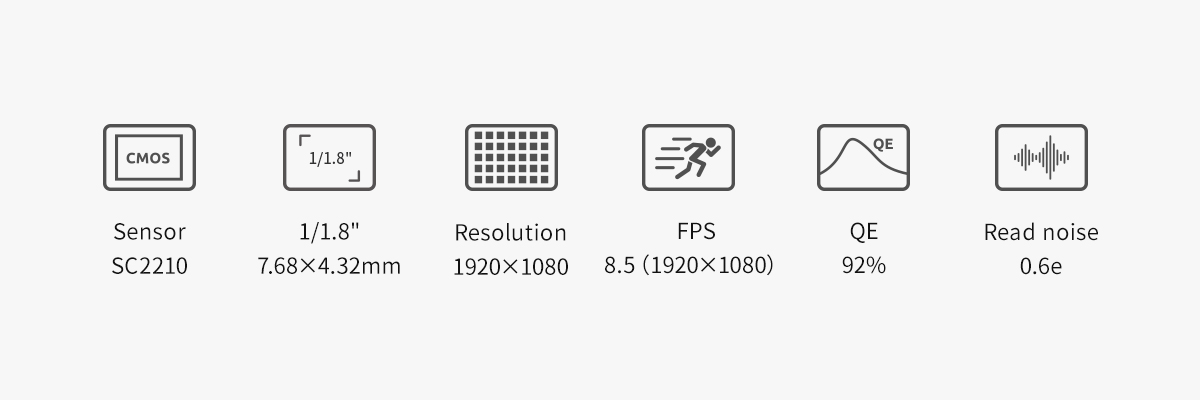
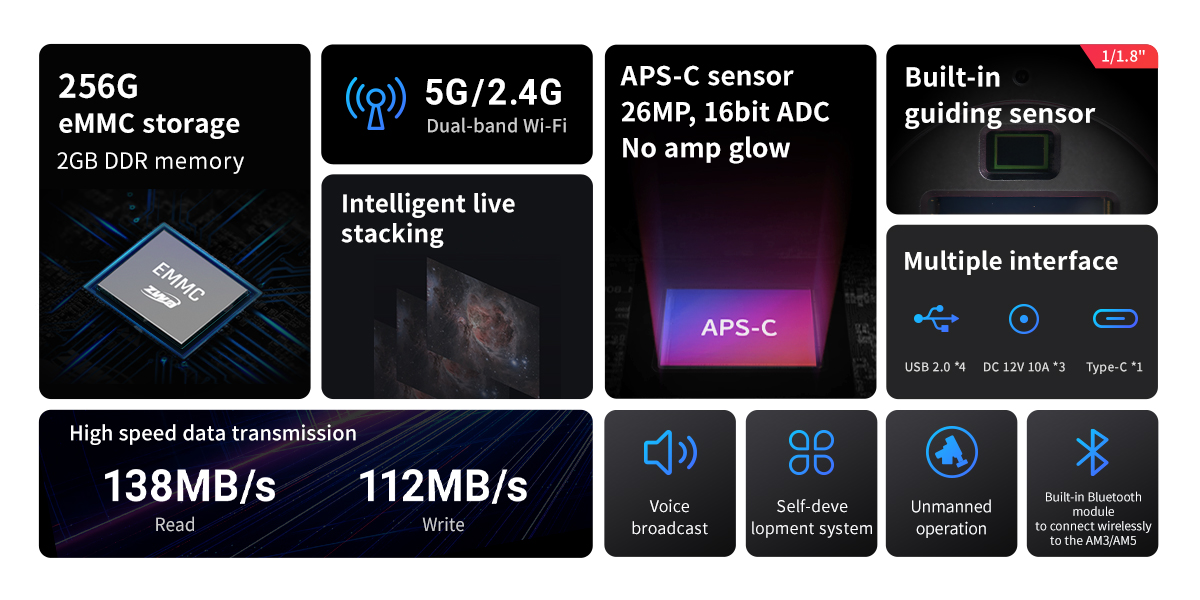
ZWO ASI2600MC Air guide sensor

ZWO ASI2600MC Air integrated guide camera illustration

ZWO ASI2600MC Air camera design

Designed for Easier Astrophotography

The ASI2600MC Air is designed to make serious astrophotography easier without reducing image quality. This is important because many beginners quickly discover that the camera is only one part of the challenge. Power, guiding, focusing, storage, software and cable routing all matter.

By combining so much of the imaging system into one device, ZWO has made the overall experience more approachable. A user upgrading from a DSLR or smart telescope can move into proper cooled deep-sky imaging without immediately building a complicated multi-box rig.

Experienced astrophotographers will also appreciate the cleaner setup. Fewer cables usually means fewer problems, especially when imaging through a meridian flip or operating remotely from indoors.

ZWO ASI2600MC Air portable astrophotography setup

Connectivity and Cable Management

The ASI2600MC Air includes 4 x USB 2.0 ports, 3 x 12V DC power ports and a USB Type-C port. This allows accessories such as an electronic focuser, filter wheel and mount connection to be routed directly through the camera.

This is one of the biggest real-world advantages of the Air design. Cable management can make or break an imaging rig. A neat setup is easier to balance, less likely to snag, and much quicker to troubleshoot.

When paired with ZWO accessories such as the EAF, EFW, AM3 or AM5, the result is a very tidy and modern astrophotography system.

ZWO ASI2600MC Air connectivity ports

ZWO ASI2600MC Air cable management and connections

Storage and Stability

The built-in 256GB eMMC storage gives the ASI2600MC Air enough internal capacity for substantial imaging sessions. This is especially useful for portable imaging where you may not want to rely on a laptop or external drive at the telescope.

External storage up to 1TB can also be supported via USB 2.0, giving more flexibility for longer sessions or multi-target nights.

For most users, the key benefit is convenience. Images can be captured, stored and transferred with fewer devices attached to the telescope. That makes the system feel more like a purpose-built astrophotography appliance rather than a collection of separate electronics.

ZWO ASI2600MC Air internal storage

Full Well Capacity and Dynamic Range

The ASI2600MC Air offers an impressive full well capacity, with the standard IMX571 performance enhanced by ZWO's expanded full well technology. In expanded mode, the camera can reach up to 73ke full well capacity.

This matters because astrophotography often involves capturing very bright stars and extremely faint nebulosity in the same image. Greater full well capacity helps reduce the risk of bright stars saturating too quickly, while preserving subtle detail in fainter areas.

Combined with the native 16-bit ADC and low read noise, this makes the ASI2600MC Air very capable for high dynamic range deep-sky targets such as M42, M31, the Rosette Nebula, the North America Nebula and large dusty star fields.

ZWO ASI2600MC Air deep sky image example

Dual-Band Wi-Fi

The ASI2600MC Air includes an external dual-band antenna supporting both 2.4GHz and 5GHz Wi-Fi. This gives users flexibility depending on the imaging environment.

2.4GHz generally offers better range, while 5GHz can provide faster performance over shorter distances. For garden observatories, patios, driveways and portable setups, the wireless control option is one of the features that makes the Air series so appealing.

As with any Wi-Fi controlled astronomy system, performance will depend on distance, obstructions and local interference. But the integrated antenna design is a welcome improvement for users who want to control the rig from a phone or tablet.

ZWO ASI2600MC Air dual-band WiFi antenna

Software and Control

The ASI2600MC Air works with the ASIAIR App, allowing users to control imaging, guiding, mount movement, focusing and sequencing from a mobile device. This is one of the biggest attractions of the ZWO ecosystem.

The ASIAIR interface is popular because it makes deep-sky imaging easier to understand. Plate solving, polar alignment, target framing, guiding, autofocus and imaging plans are all handled in one place.

The camera can also connect to ZWO's ASI Studio software, and third-party PC software can be supported through ASCOM Alpaca, provided the correct ASCOM platform requirements are met.

ZWO ASI2600MC Air software control

Bluetooth Support and AM3 / AM5 Integration

The ASI2600MC Air also supports Bluetooth connection, helping create an even cleaner system when used with compatible ZWO equipment.

When paired with the ZWO AM3 or AM5 harmonic drive mounts, the ASI2600MC Air makes a lot of sense. These mounts are often chosen for portability and low weight, so reducing the amount of extra equipment on the telescope is a genuine advantage.

The result is a compact imaging rig that is easier to transport, quicker to assemble and much less cluttered than a traditional setup.

ZWO ASI2600MC Air with AM3 and AM5 mount integration

ASIAIR App Experience

The ASIAIR App is one of the main reasons many astrophotographers choose ZWO equipment. It allows the entire imaging workflow to be managed from a phone or tablet, including polar alignment, guiding, focusing, target selection, plate solving, exposure control and image capture.

For beginners, this makes the learning curve much more manageable. For experienced users, it provides a streamlined way to run repeatable imaging sessions without needing a laptop at the telescope.

Live stacking is also supported, which is useful for outreach, quick previews and electronically assisted astronomy-style observing.

ZWO ASIAIR App control with ASI2600MC Air

Live Stacking and Sharing

The ASI2600MC Air can be used for serious long-exposure imaging, but it also supports more immediate workflows such as live stacking. This is useful when demonstrating the night sky to others, checking framing, or quickly seeing whether a target is worth continuing.

Brightness and contrast adjustments can be made in the app, and images can be shared more easily with astronomy communities and social media platforms.

While dedicated post-processing software will still produce the best final results, live stacking adds a layer of convenience and enjoyment to the imaging process.

ZWO ASI2600MC Air live stacking and sharing

ZWO Ecosystem Benefits

The ASI2600MC Air is strongest when used as part of the wider ZWO ecosystem. With compatible mounts, focusers, filter wheels and accessories, the whole system becomes easier to control from one app.

This is not necessarily the camera for someone who wants to mix and match every brand of hardware and software. But for users who like the ASIAIR workflow, the Air design is one of the cleanest ways to build a complete imaging system.

ZWO also continues to update its app and ecosystem, so the camera benefits from ongoing software improvements and added features over time.

ZWO self-developed system for ASI2600MC Air

Quantum Efficiency

The main IMX571 sensor offers excellent sensitivity for one-shot colour deep-sky imaging. The colour sensor, combined with low read noise and strong cooling performance, makes the ASI2600MC Air suitable for broadband targets and dual-band narrowband imaging with suitable filters.

The guide sensor is also highly sensitive, which helps maintain reliable guiding performance across a wide range of targets and sky conditions.

ZWO ASI2600MC Air main sensor QE graph
QE of Main Sensor
ZWO ASI2600MC Air guide sensor QE graph
QE of Guide Sensor

Dark Current and Cooling Performance

Cooling is one of the main reasons to choose a dedicated astronomy camera over a DSLR or mirrorless camera. The ASI2600MC Air uses TEC cooling to reduce thermal noise during long exposures.

This is especially important for summer imaging, long narrowband exposures and multi-hour deep-sky sessions. Lower dark current makes calibration easier and helps preserve faint detail in nebulae and galaxies.

ZWO ASI2600MC Air dark current graph

Power Consumption

The integrated design means power planning is important. The camera can power connected accessories, but users should still ensure they use a suitable 12V power supply with enough capacity for the camera, cooling, mount and accessories.

For portable imaging, a quality field battery or regulated power source is recommended. Stable power is essential for reliable cooling, guiding and long imaging sequences.

ZWO ASI2600MC Air power consumption graph

IR-Cut Coating for Colour Imaging

As a one-shot colour camera, the ASI2600MC Air includes an IR-cut protective window. This helps maintain correct colour balance and keeps unwanted infrared light from affecting star sharpness and image quality.

For most users, this makes the camera straightforward to use for broadband RGB imaging. For emission nebulae under light pollution, a suitable dual-band filter can be added to improve contrast.

ZWO ASI2600MC Air IR cut coating

Frame Rate

The ASI2600MC Air is primarily a deep-sky camera rather than a planetary camera. Its APS-C sensor and cooling system are designed for long-exposure imaging, not high-speed planetary capture.

It can still be used for lunar and solar work with the right setup, but if your main interest is planets, a smaller high-frame-rate camera such as the ASI678MC may be more suitable.

ZWO ASI2600MC Air frame rate chart

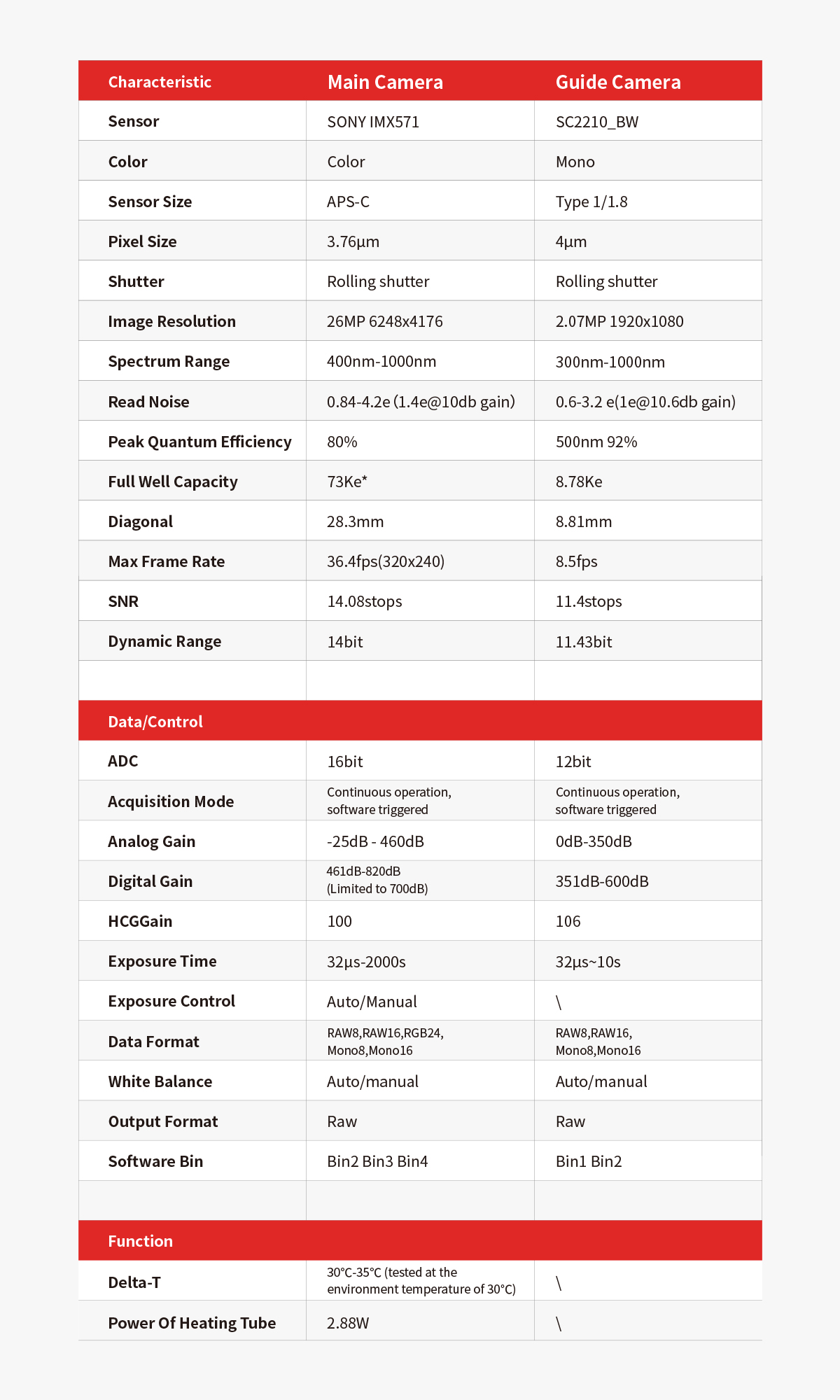
Camera Specification

The ASI2600MC Air specification places it firmly in the premium deep-sky imaging category. The combination of APS-C sensor size, 16-bit output, low read noise, TEC cooling and integrated smart control makes it one of the most complete colour astrophotography cameras currently available.

ZWO ASI2600MC Air camera specification chart

ZWO ASI2600MC Air full specification details

Camera Details

The physical design of the ASI2600MC Air is compact considering how much functionality is built into the camera body. This is particularly useful for portable rigs where size, weight and cable routing are important.

ZWO ASI2600MC Air camera body details

55mm Back Focus Solution

Many astrophotography telescopes, flatteners and reducers require a 55mm back focus distance. ZWO provides a practical spacing solution to help users achieve the correct distance from the sensor to the optical corrector.

Correct back focus is important. If spacing is wrong, stars may appear stretched or distorted toward the edges of the frame, especially with an APS-C sensor. Taking time to get this right will help the ASI2600MC Air perform at its best.

ZWO ASI2600MC Air 55mm back focus solution

Mechanical Diagram

The mechanical diagram is useful when planning adapters, spacing, reducers, flatteners and rotators. This is especially important for users building a complete imaging train around refractors or corrected astrographs.

ZWO ASI2600MC Air mechanical diagram

What is in the Box?

The ASI2600MC Air includes the camera body and the required accessories shown below. Always check the current product listing for the latest package contents, as supplied accessories can vary by production batch or region.

ZWO ASI2600MC Air box contents

Who Should Buy the ZWO ASI2600MC Air?

The ASI2600MC Air is ideal for astrophotographers who want a serious deep-sky camera but do not want a complicated, cable-heavy setup.

  • DSLR users upgrading to a cooled astronomy camera: The improvement in cooling, sensitivity and workflow is significant.
  • Seestar or smart telescope users wanting to go further: This is a major step into proper telescope-based deep-sky imaging.
  • Portable imagers: Fewer boxes and fewer cables make setup much easier.
  • ZWO AM3 and AM5 users: The camera fits naturally into a modern ZWO ecosystem.
  • Refractor owners: The APS-C sensor pairs beautifully with many wide-field and medium focal length refractors.
  • Experienced imagers wanting a cleaner rig: The image quality is proven, but the system is much neater.

Who Might Prefer Something Else?

No camera is perfect for everyone. The ASI2600MC Air is excellent, but there are situations where another model may be a better fit.

  • Mono narrowband specialists: Consider the ASI2600MM Pro or mono Air version if you want full LRGB and narrowband control.
  • Planetary imagers: A smaller high-speed planetary camera may be more suitable.
  • Budget beginners: The ASI533MC Pro may be a more affordable first cooled camera.
  • Users outside the ZWO ecosystem: If you prefer NINA, mini PCs and mixed-brand hardware, a traditional camera may suit you better.

Recommended Telescope Pairings

Telescope Why it works well
ZWO FF65 APO Excellent portable wide-field pairing with APS-C coverage.
ZWO FF107 APO A strong premium refractor pairing for larger nebulae and galaxies.
Askar SQA85 Superb wide-field astrograph option with a flat, corrected field.
Askar FRA500 Very versatile focal length for nebulae, galaxies and clusters.
Askar 107PHQ Excellent for users wanting a more serious refractor system.

Pros

  • Excellent Sony IMX571 APS-C sensor
  • Very strong deep-sky image quality
  • Built-in guide camera
  • Integrated ASIAIR control
  • Cleaner cable management
  • Internal storage
  • Dual-band Wi-Fi
  • Ideal for AM3 and AM5 setups
  • Great choice for portable imaging
  • Strong long-term upgrade path within the ZWO ecosystem

Considerations

  • Premium price compared with simpler cooled cameras
  • Best suited to users who like the ZWO ecosystem
  • Colour camera, not mono
  • Not primarily designed for planetary imaging
  • Long focal length users may still prefer separate guiding options

Frequently Asked Questions

Is the ZWO ASI2600MC Air good for beginners?

Yes, but it is a premium option. It is easier to use than many traditional deep-sky setups because ASIAIR control, guiding and connectivity are built in. However, complete beginners on a smaller budget may also consider the ASI533MC Pro.

Is the ASI2600MC Air better than the ASI2600MC Pro?

Image quality is based around the same excellent IMX571 sensor family, but the Air adds integrated ASIAIR control, a guide camera, storage and power management. The MC Pro may suit users who already have a separate control system.

Does the ASI2600MC Air need a separate guide camera?

For many refractor setups, no. It has a built-in SC2210 guide sensor. Some longer focal length systems may still benefit from an off-axis guider or separate guide solution.

Can I use the ASI2600MC Air with the ZWO AM3 or AM5?

Yes. It is an excellent match for both mounts and helps create a clean, portable imaging setup.

Is the ASI2600MC Air suitable for galaxies?

Yes. With the right telescope, it is very capable for galaxies. A medium focal length refractor or longer corrected telescope will give better image scale for smaller galaxies.

Is it good for nebulae?

Yes. The APS-C sensor is excellent for large nebulae, and the colour sensor works well with suitable dual-band filters under light-polluted skies.

Does it work without a laptop?

Yes. The ASIAIR App allows control from a phone or tablet, making laptop-free imaging possible.

Can I use it with NINA?

The ASI2600MC Air is primarily designed around the ASIAIR ecosystem, but ZWO states that third-party PC software can be supported through ASCOM Alpaca when the correct ASCOM requirements are met.

Is APS-C better than a smaller sensor?

APS-C gives a wider field of view than smaller sensors such as 1-inch or 4/3-inch formats. This is useful for large nebulae, star fields and framing flexibility.

What filters should I use?

For broadband imaging, a UV/IR or built-in IR-cut solution is suitable. For emission nebulae under light pollution, a dual-band filter is highly recommended.

Final Verdict

The ZWO ASI2600MC Air is one of the most complete one-shot colour astrophotography cameras currently available. It takes the proven image quality of the IMX571 APS-C sensor and combines it with the practical features astrophotographers actually need in the field: guiding, control, storage, power distribution and cleaner cabling.

For anyone building a premium portable deep-sky imaging system, especially around the ZWO AM3 or AM5, this camera is extremely easy to recommend. It is not the cheapest route into cooled astrophotography, but it is one of the neatest, most capable and most user-friendly solutions available.

If you want high-quality deep-sky images without building a complicated multi-box rig, the ASI2600MC Air is one of the strongest options in the ZWO range.


Considering the ZWO ASI2600MC Air?

The ASI2600MC Air is one of the most advanced one-shot colour astronomy cameras available, but the best choice always depends on your telescope, mount, targets and experience level.

Our ZWO camera buying guide compares the ASI2600MC Air with other popular models including the ASI2600MM Pro, ASI533MC Pro, ASI678MC and ASI174MM Mini.

Read the Ultimate ZWO Camera Buying Guide →

```

ZWO ASI 2600MC Air – 26MP APS-C Sensor, Wi-Fi Astrophotography Camera

Regular price £2,149.00
Or £716.33 × 3 interest-free with PayPal

ZWO-ASI2600MC-AIR

Specifications

ZWO ASI2600MC Air Review – All-in-One Deep Sky Imaging Camera

The ZWO ASI2600MC Air is one of the most important astrophotography cameras ZWO has released in recent years. It combines a premium APS-C cooled colour imaging camera, built-in guide camera, ASIAIR smart control, Wi-Fi, storage, USB hub and 12V power distribution into one compact unit.

For many astrophotographers, the biggest challenge is no longer simply choosing a good sensor. It is building a reliable imaging system that is easy to set up, easy to power, easy to control and not buried under a mess of cables. The ASI2600MC Air directly addresses that problem.

At the centre of the camera is the excellent Sony IMX571 APS-C sensor, already well known from the popular ASI2600MC Pro. What makes the Air version different is the level of integration. Instead of needing a separate ASIAIR, guide camera, USB hub and power distribution system, much of that functionality is built into the camera body itself.

This makes the ASI2600MC Air especially attractive for portable astrophotography, ZWO AM3 and AM5 users, refractor-based imaging rigs, and anyone who wants a cleaner, simpler route into serious deep-sky imaging.

Dark Clear Skies Verdict

Overall rating: 9.8/10

The ZWO ASI2600MC Air is a superb choice for astrophotographers who want premium APS-C image quality with a much simpler setup. The proven IMX571 sensor delivers excellent deep-sky performance, while the built-in guide camera, ASIAIR control, storage and power management make the whole imaging rig cleaner and easier to manage.

Best for: deep-sky imaging, portable setups, ZWO AM3/AM5 users, advanced beginners, refractor owners and anyone wanting a highly integrated astrophotography system.

Key Features

  • 26MP Sony IMX571 APS-C colour sensor
  • 6248 x 4176 resolution
  • 3.76µm pixel size
  • Built-in SC2210 guide sensor from the ASI220MM Mini
  • Integrated ASIAIR smart control
  • 256GB internal eMMC storage
  • Dual-band 2.4G / 5G Wi-Fi
  • 4 x USB 2.0 ports
  • 3 x 12V DC power ports
  • USB-C connection for fast file transfer
  • Two-stage TEC cooling
  • IR-cut protective window for colour imaging
  • Supports ASIAIR App, ASI Studio and Alpaca-compatible third-party software

ZWO ASI2600MC Air astrophotography camera overview

Why the ASI2600MC Air is Different

The ASI2600MC Air is not just another cooled colour camera. It is closer to a complete astrophotography control centre built around a premium imaging sensor.

A traditional deep-sky setup often needs a main camera, guide camera, guide scope or off-axis guider, ASIAIR or mini PC, USB hub, power distribution unit and multiple cables running between everything. That works well, but it can be fiddly, especially in the dark or when imaging away from home.

The ASI2600MC Air reduces that complexity. With the guide camera, smart controller, storage, USB connectivity and power outputs built in, the system becomes much neater. There are fewer points of failure and fewer cables to catch, pull loose or route around the mount.

For portable imagers, this is a major advantage. It means faster setup, faster pack-down and less time troubleshooting equipment when you should be collecting photons.

Sony IMX571 APS-C Sensor

The main imaging sensor is Sony's highly regarded IMX571, a 26MP APS-C back-illuminated CMOS sensor. This sensor has become one of the most trusted choices in modern amateur astrophotography because it offers an excellent balance of field of view, resolution, sensitivity and low noise.

The APS-C format is large enough to capture wide nebulae, galaxy groups and star fields, while still being manageable for many modern refractors and corrected telescopes. With a sensor size of 23.5mm x 15.7mm and a 28.3mm diagonal, it pairs particularly well with telescopes that provide a well-corrected APS-C image circle.

The 3.76µm pixels are also a very useful size. They work well with short to medium focal length refractors and provide a sensible image scale for typical UK seeing conditions. This makes the ASI2600MC Air a very versatile camera rather than something suited to only one type of telescope.

ZWO ASI2600MC Air IMX571 APS-C sensor details

Built-In Guide Camera

One of the most useful features of the ASI2600MC Air is the integrated guide sensor. ZWO uses the SC2210 sensor, the same sensor family used in the ASI220MM Mini guide camera.

This sensor is highly sensitive, with a quoted QE peak of 92% at 500nm and very low read noise. In practical terms, that means it is well suited to finding guide stars and maintaining accurate tracking during long-exposure imaging.

For many refractor-based setups, the built-in guide camera can remove the need for a separate guide camera and additional cabling. This is especially useful when building a clean AM3 or AM5 setup where simplicity and balance matter.

There will still be some setups where an external guide solution or off-axis guider may be preferred, particularly with longer focal length telescopes. But for many wide-field and medium focal length refractor systems, the built-in guide camera is a major convenience.
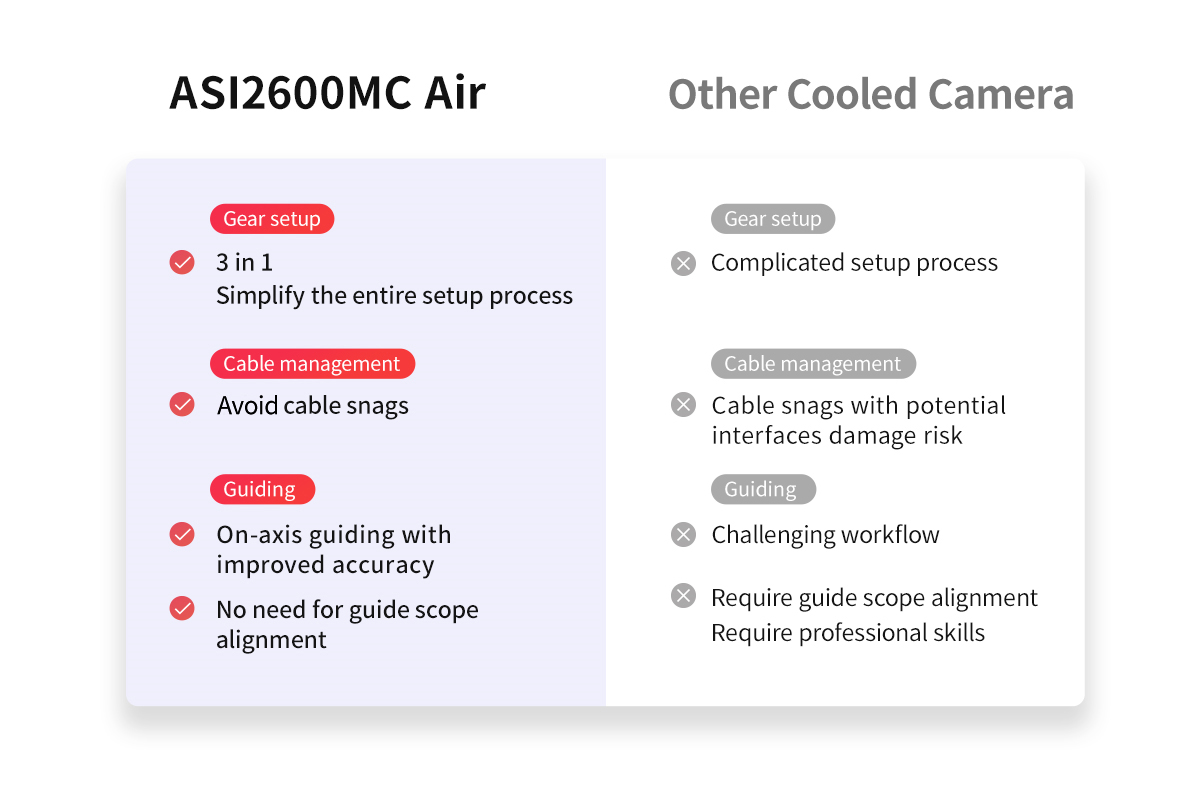
ZWO ASI2600MC Air guide sensor

ZWO ASI2600MC Air integrated guide camera illustration

ZWO ASI2600MC Air camera design

Designed for Easier Astrophotography

The ASI2600MC Air is designed to make serious astrophotography easier without reducing image quality. This is important because many beginners quickly discover that the camera is only one part of the challenge. Power, guiding, focusing, storage, software and cable routing all matter.

By combining so much of the imaging system into one device, ZWO has made the overall experience more approachable. A user upgrading from a DSLR or smart telescope can move into proper cooled deep-sky imaging without immediately building a complicated multi-box rig.

Experienced astrophotographers will also appreciate the cleaner setup. Fewer cables usually means fewer problems, especially when imaging through a meridian flip or operating remotely from indoors.
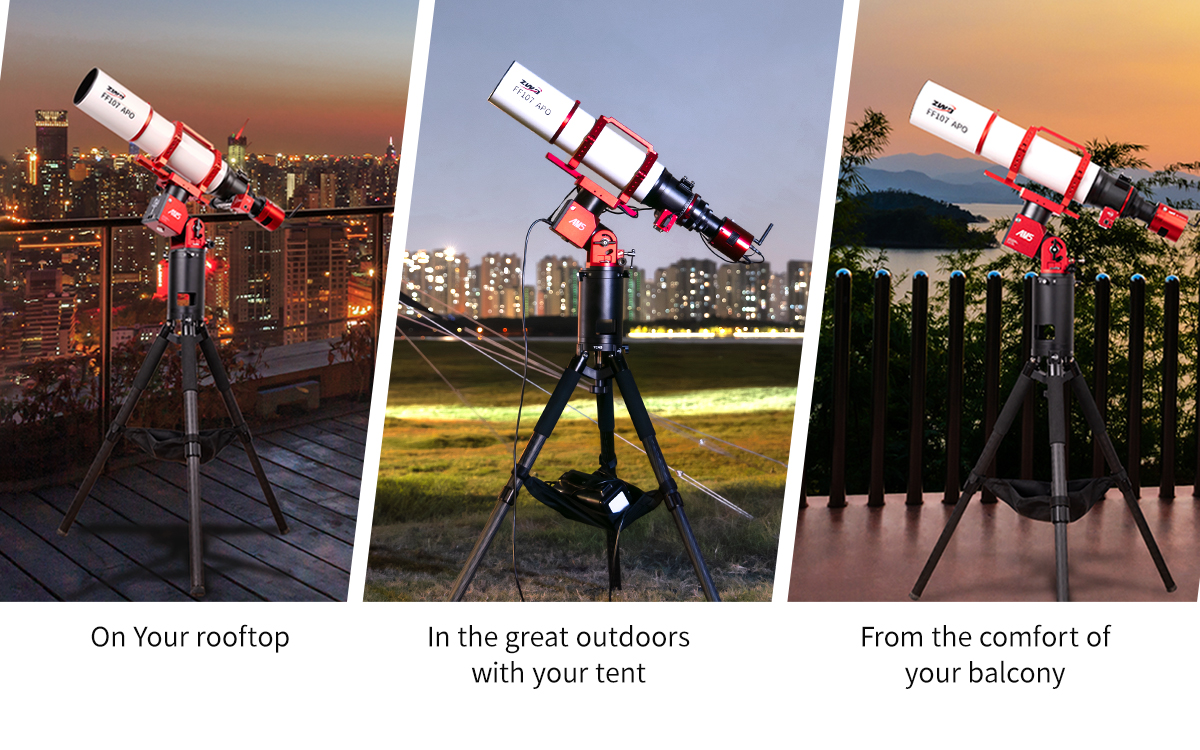
ZWO ASI2600MC Air portable astrophotography setup

Connectivity and Cable Management

The ASI2600MC Air includes 4 x USB 2.0 ports, 3 x 12V DC power ports and a USB Type-C port. This allows accessories such as an electronic focuser, filter wheel and mount connection to be routed directly through the camera.

This is one of the biggest real-world advantages of the Air design. Cable management can make or break an imaging rig. A neat setup is easier to balance, less likely to snag, and much quicker to troubleshoot.

When paired with ZWO accessories such as the EAF, EFW, AM3 or AM5, the result is a very tidy and modern astrophotography system.
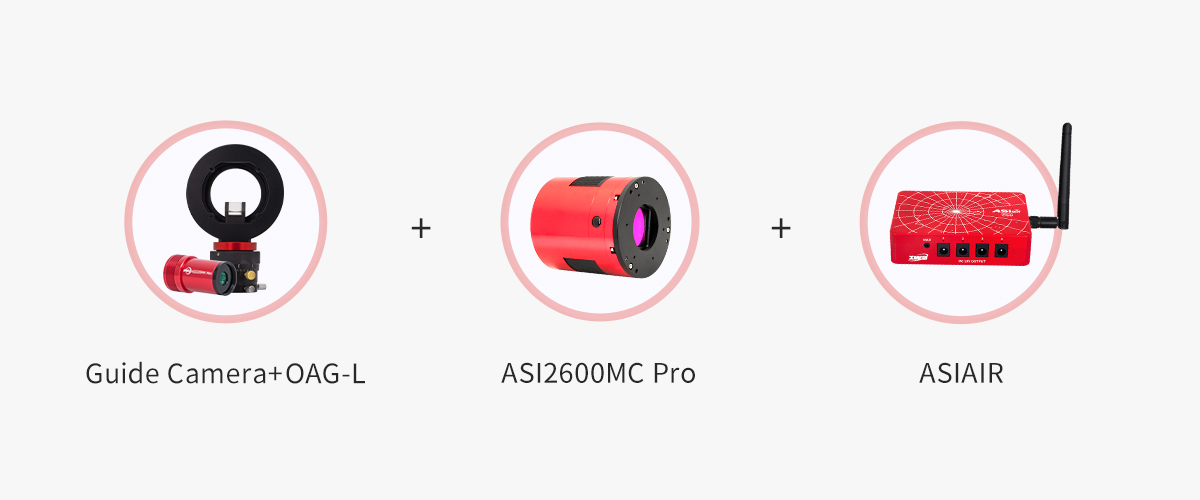
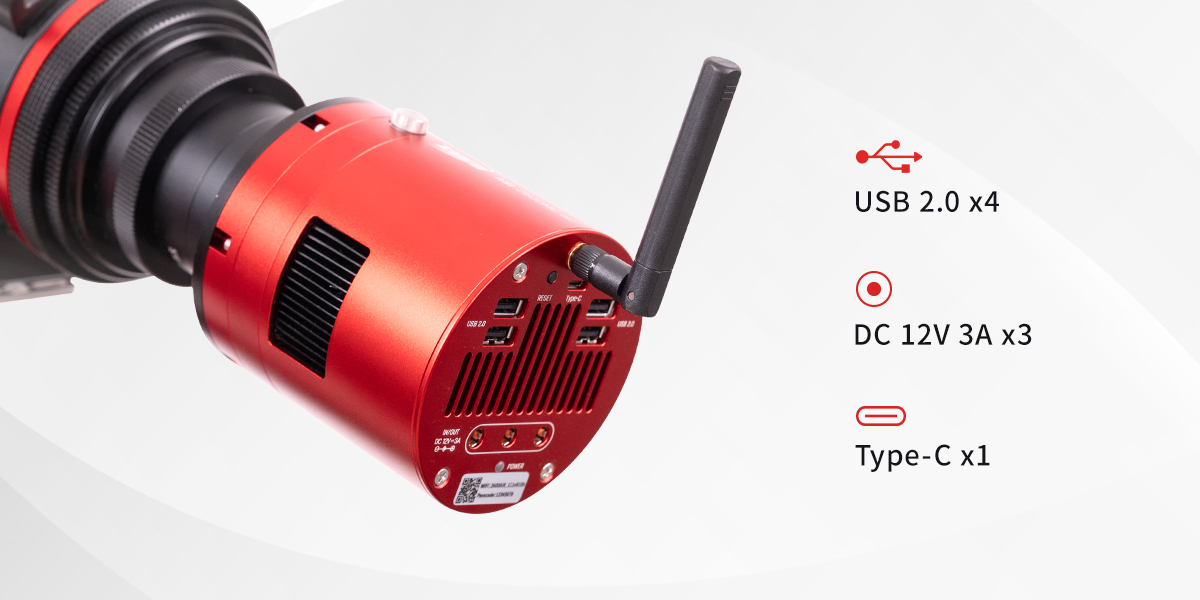
ZWO ASI2600MC Air connectivity ports

ZWO ASI2600MC Air cable management and connections

Storage and Stability

The built-in 256GB eMMC storage gives the ASI2600MC Air enough internal capacity for substantial imaging sessions. This is especially useful for portable imaging where you may not want to rely on a laptop or external drive at the telescope.

External storage up to 1TB can also be supported via USB 2.0, giving more flexibility for longer sessions or multi-target nights.

For most users, the key benefit is convenience. Images can be captured, stored and transferred with fewer devices attached to the telescope. That makes the system feel more like a purpose-built astrophotography appliance rather than a collection of separate electronics.
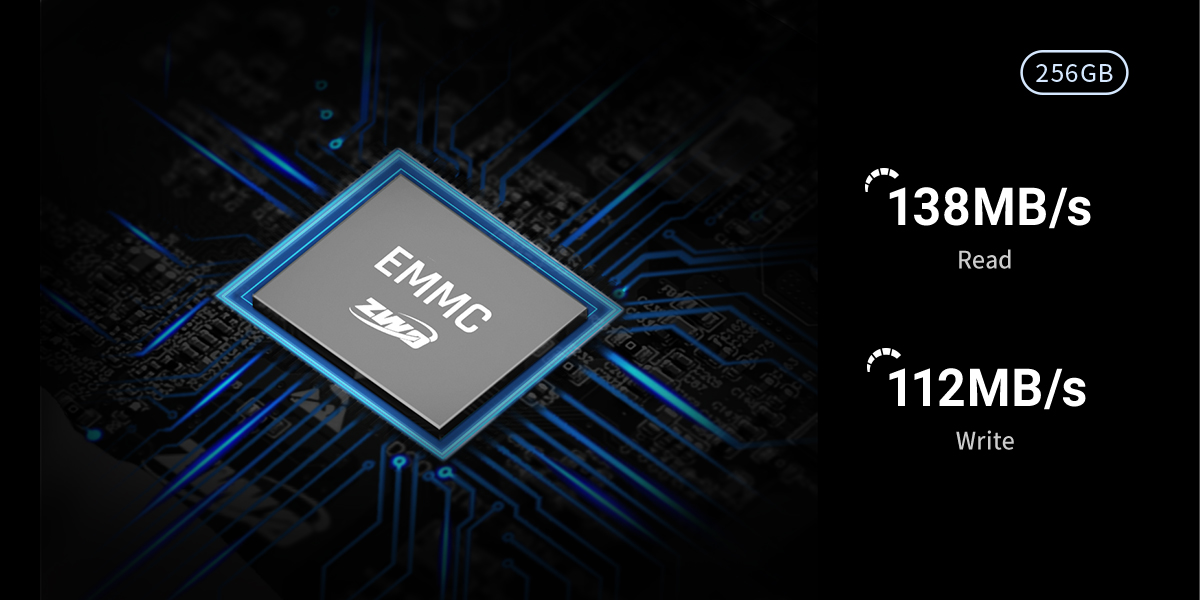
ZWO ASI2600MC Air internal storage

Full Well Capacity and Dynamic Range

The ASI2600MC Air offers an impressive full well capacity, with the standard IMX571 performance enhanced by ZWO's expanded full well technology. In expanded mode, the camera can reach up to 73ke full well capacity.

This matters because astrophotography often involves capturing very bright stars and extremely faint nebulosity in the same image. Greater full well capacity helps reduce the risk of bright stars saturating too quickly, while preserving subtle detail in fainter areas.

Combined with the native 16-bit ADC and low read noise, this makes the ASI2600MC Air very capable for high dynamic range deep-sky targets such as M42, M31, the Rosette Nebula, the North America Nebula and large dusty star fields.
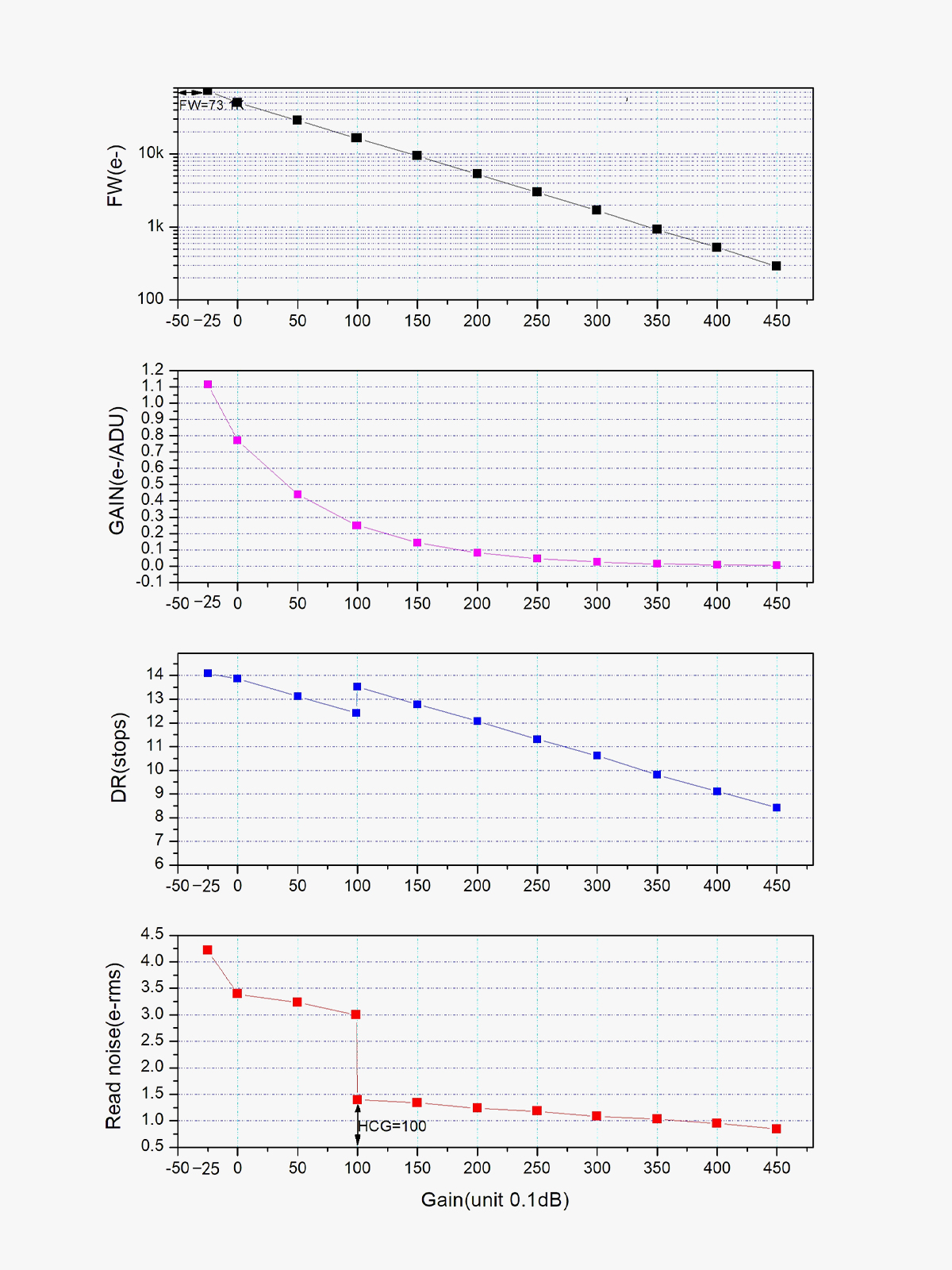
ZWO ASI2600MC Air deep sky image example

Dual-Band Wi-Fi

The ASI2600MC Air includes an external dual-band antenna supporting both 2.4GHz and 5GHz Wi-Fi. This gives users flexibility depending on the imaging environment.

2.4GHz generally offers better range, while 5GHz can provide faster performance over shorter distances. For garden observatories, patios, driveways and portable setups, the wireless control option is one of the features that makes the Air series so appealing.

As with any Wi-Fi controlled astronomy system, performance will depend on distance, obstructions and local interference. But the integrated antenna design is a welcome improvement for users who want to control the rig from a phone or tablet.
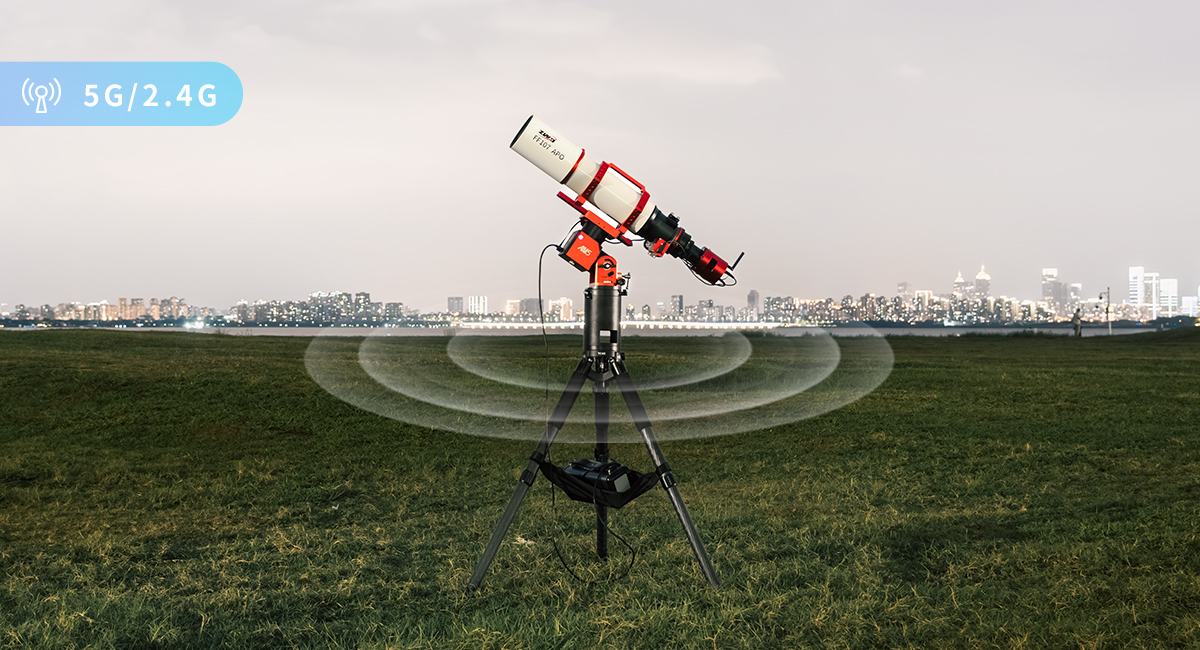
ZWO ASI2600MC Air dual-band WiFi antenna

Software and Control

The ASI2600MC Air works with the ASIAIR App, allowing users to control imaging, guiding, mount movement, focusing and sequencing from a mobile device. This is one of the biggest attractions of the ZWO ecosystem.

The ASIAIR interface is popular because it makes deep-sky imaging easier to understand. Plate solving, polar alignment, target framing, guiding, autofocus and imaging plans are all handled in one place.

The camera can also connect to ZWO's ASI Studio software, and third-party PC software can be supported through ASCOM Alpaca, provided the correct ASCOM platform requirements are met.
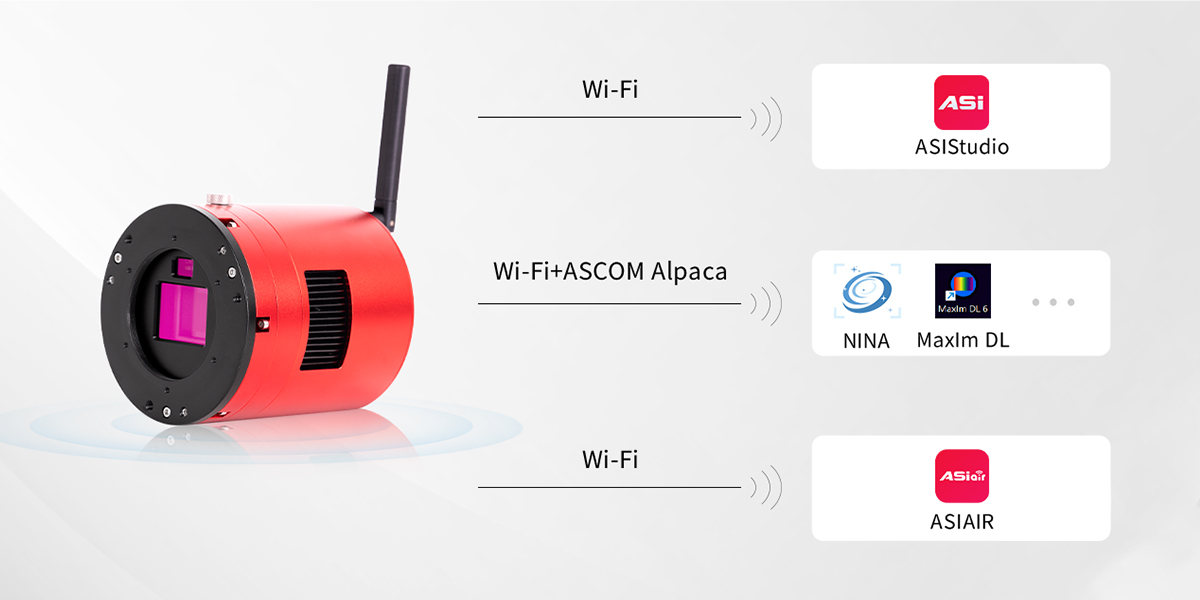
ZWO ASI2600MC Air software control

Bluetooth Support and AM3 / AM5 Integration

The ASI2600MC Air also supports Bluetooth connection, helping create an even cleaner system when used with compatible ZWO equipment.

When paired with the ZWO AM3 or AM5 harmonic drive mounts, the ASI2600MC Air makes a lot of sense. These mounts are often chosen for portability and low weight, so reducing the amount of extra equipment on the telescope is a genuine advantage.

The result is a compact imaging rig that is easier to transport, quicker to assemble and much less cluttered than a traditional setup.
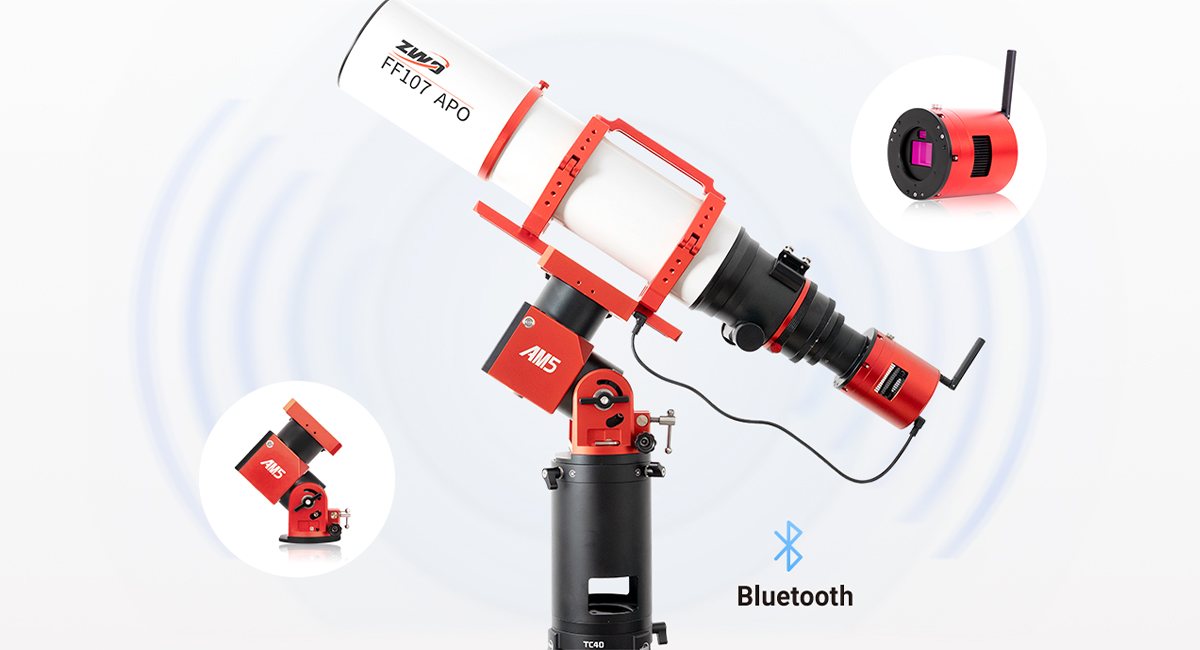
ZWO ASI2600MC Air with AM3 and AM5 mount integration

ASIAIR App Experience

The ASIAIR App is one of the main reasons many astrophotographers choose ZWO equipment. It allows the entire imaging workflow to be managed from a phone or tablet, including polar alignment, guiding, focusing, target selection, plate solving, exposure control and image capture.

For beginners, this makes the learning curve much more manageable. For experienced users, it provides a streamlined way to run repeatable imaging sessions without needing a laptop at the telescope.

Live stacking is also supported, which is useful for outreach, quick previews and electronically assisted astronomy-style observing.
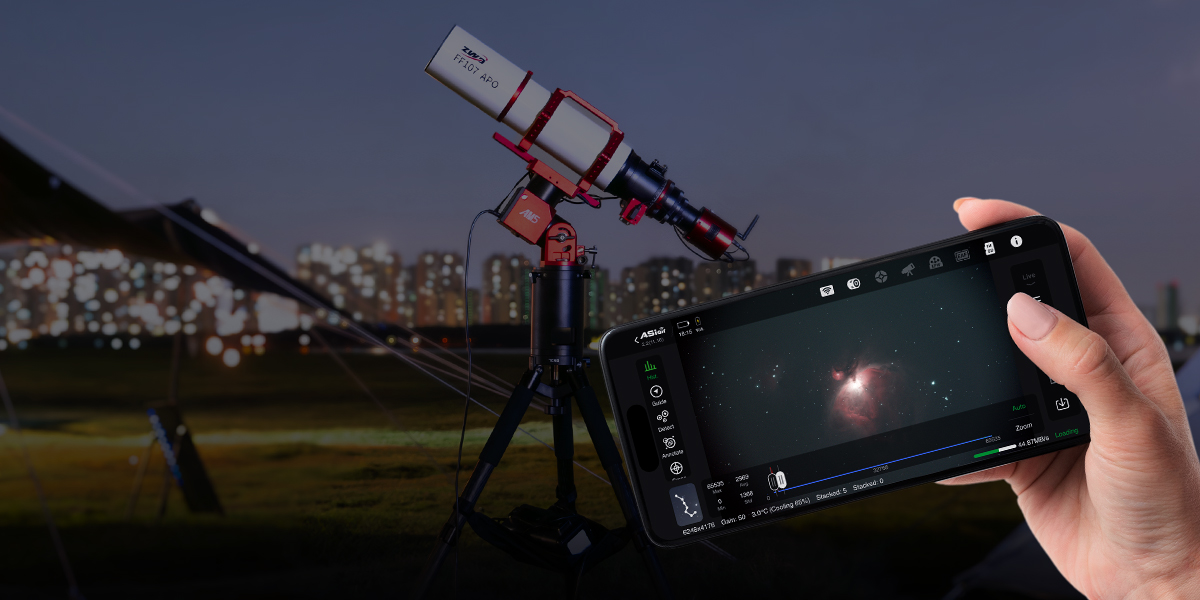
ZWO ASIAIR App control with ASI2600MC Air

Live Stacking and Sharing

The ASI2600MC Air can be used for serious long-exposure imaging, but it also supports more immediate workflows such as live stacking. This is useful when demonstrating the night sky to others, checking framing, or quickly seeing whether a target is worth continuing.

Brightness and contrast adjustments can be made in the app, and images can be shared more easily with astronomy communities and social media platforms.

While dedicated post-processing software will still produce the best final results, live stacking adds a layer of convenience and enjoyment to the imaging process.
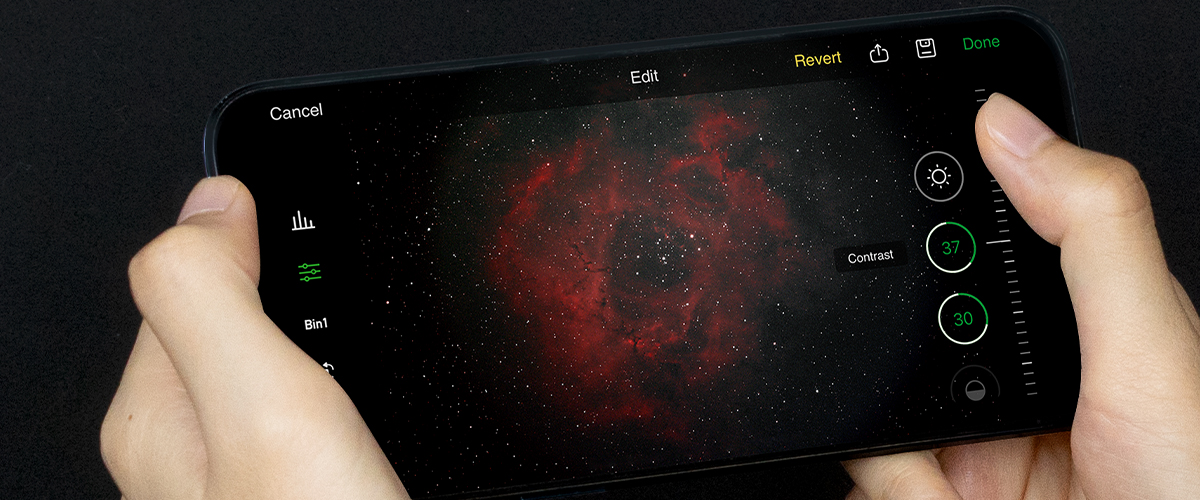
ZWO ASI2600MC Air live stacking and sharing

ZWO Ecosystem Benefits

The ASI2600MC Air is strongest when used as part of the wider ZWO ecosystem. With compatible mounts, focusers, filter wheels and accessories, the whole system becomes easier to control from one app.

This is not necessarily the camera for someone who wants to mix and match every brand of hardware and software. But for users who like the ASIAIR workflow, the Air design is one of the cleanest ways to build a complete imaging system.

ZWO also continues to update its app and ecosystem, so the camera benefits from ongoing software improvements and added features over time.

ZWO self-developed system for ASI2600MC Air

Quantum Efficiency

The main IMX571 sensor offers excellent sensitivity for one-shot colour deep-sky imaging. The colour sensor, combined with low read noise and strong cooling performance, makes the ASI2600MC Air suitable for broadband targets and dual-band narrowband imaging with suitable filters.

The guide sensor is also highly sensitive, which helps maintain reliable guiding performance across a wide range of targets and sky conditions.
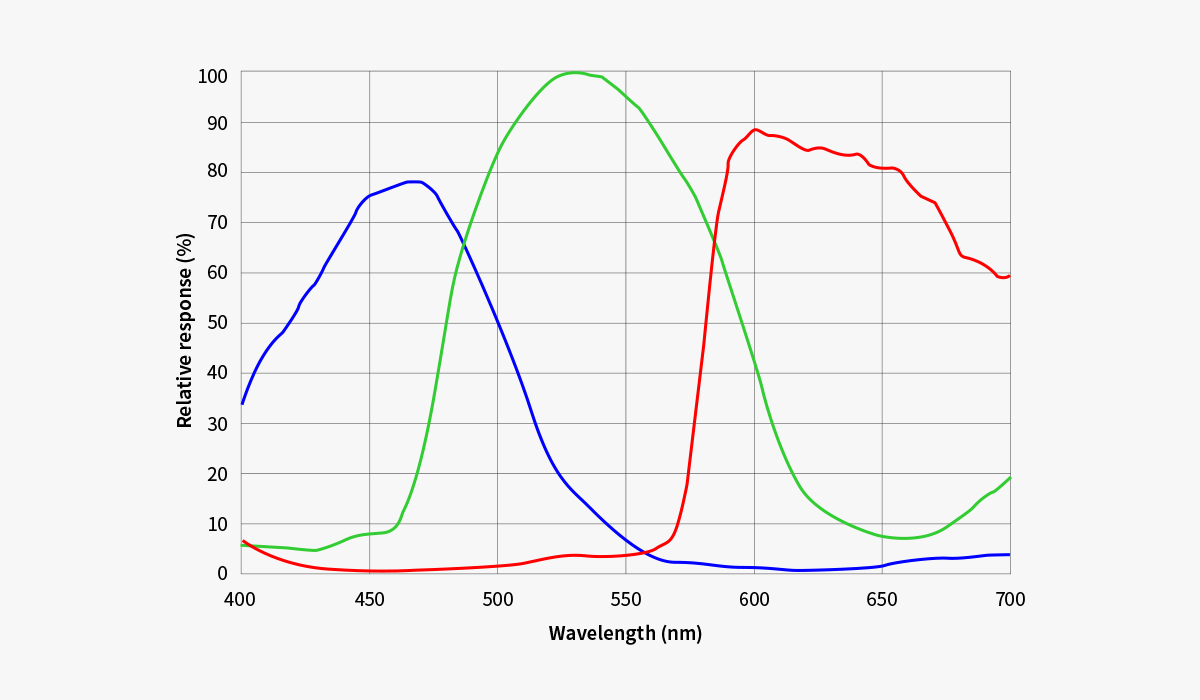
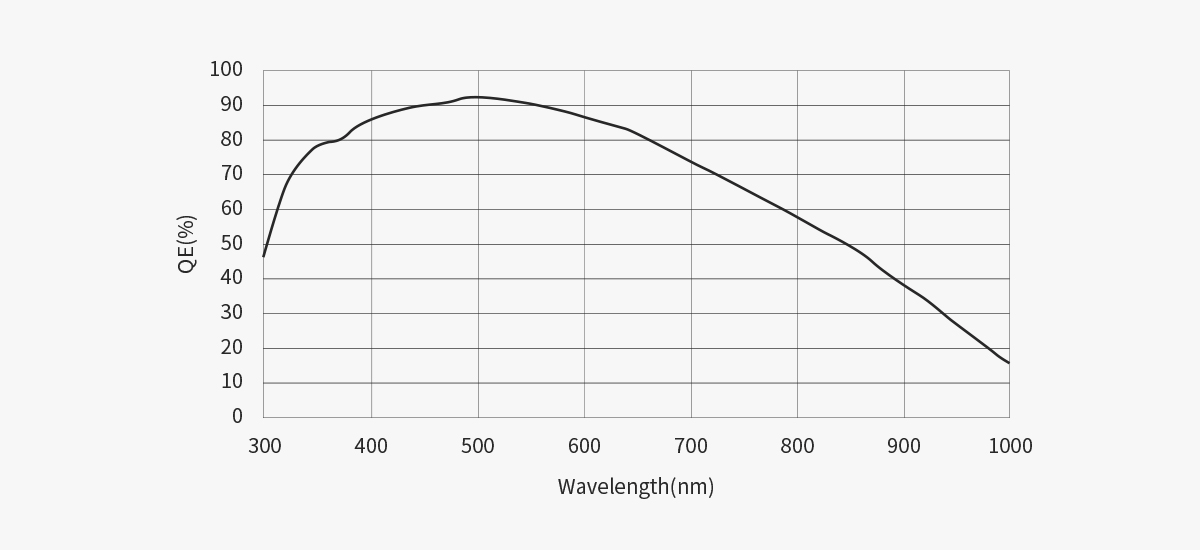
ZWO ASI2600MC Air main sensor QE graph
QE of Main Sensor
ZWO ASI2600MC Air guide sensor QE graph
QE of Guide Sensor

Dark Current and Cooling Performance

Cooling is one of the main reasons to choose a dedicated astronomy camera over a DSLR or mirrorless camera. The ASI2600MC Air uses TEC cooling to reduce thermal noise during long exposures.

This is especially important for summer imaging, long narrowband exposures and multi-hour deep-sky sessions. Lower dark current makes calibration easier and helps preserve faint detail in nebulae and galaxies.
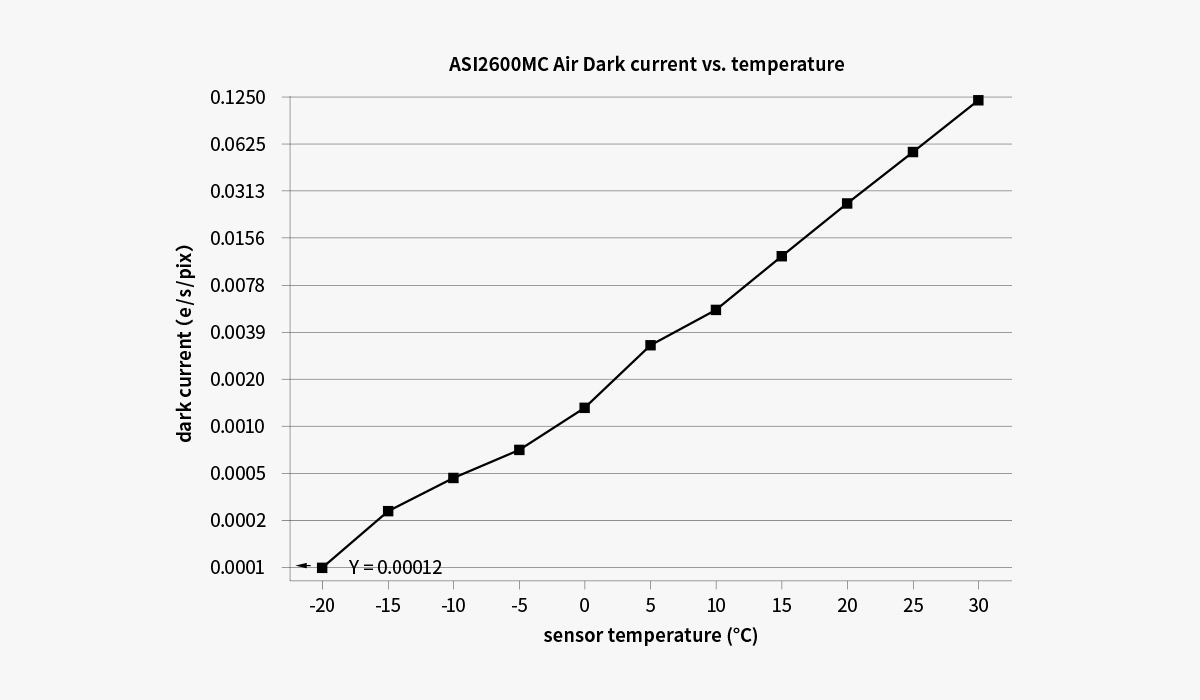
ZWO ASI2600MC Air dark current graph

Power Consumption

The integrated design means power planning is important. The camera can power connected accessories, but users should still ensure they use a suitable 12V power supply with enough capacity for the camera, cooling, mount and accessories.

For portable imaging, a quality field battery or regulated power source is recommended. Stable power is essential for reliable cooling, guiding and long imaging sequences.
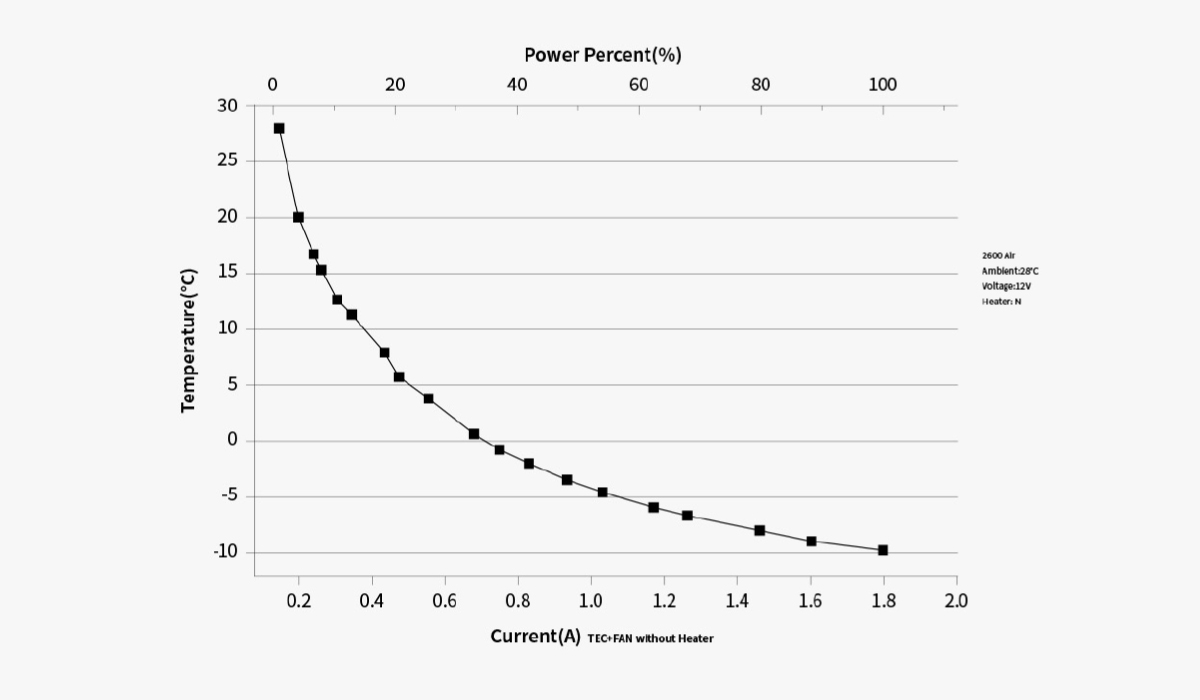
ZWO ASI2600MC Air power consumption graph

IR-Cut Coating for Colour Imaging

As a one-shot colour camera, the ASI2600MC Air includes an IR-cut protective window. This helps maintain correct colour balance and keeps unwanted infrared light from affecting star sharpness and image quality.

For most users, this makes the camera straightforward to use for broadband RGB imaging. For emission nebulae under light pollution, a suitable dual-band filter can be added to improve contrast.
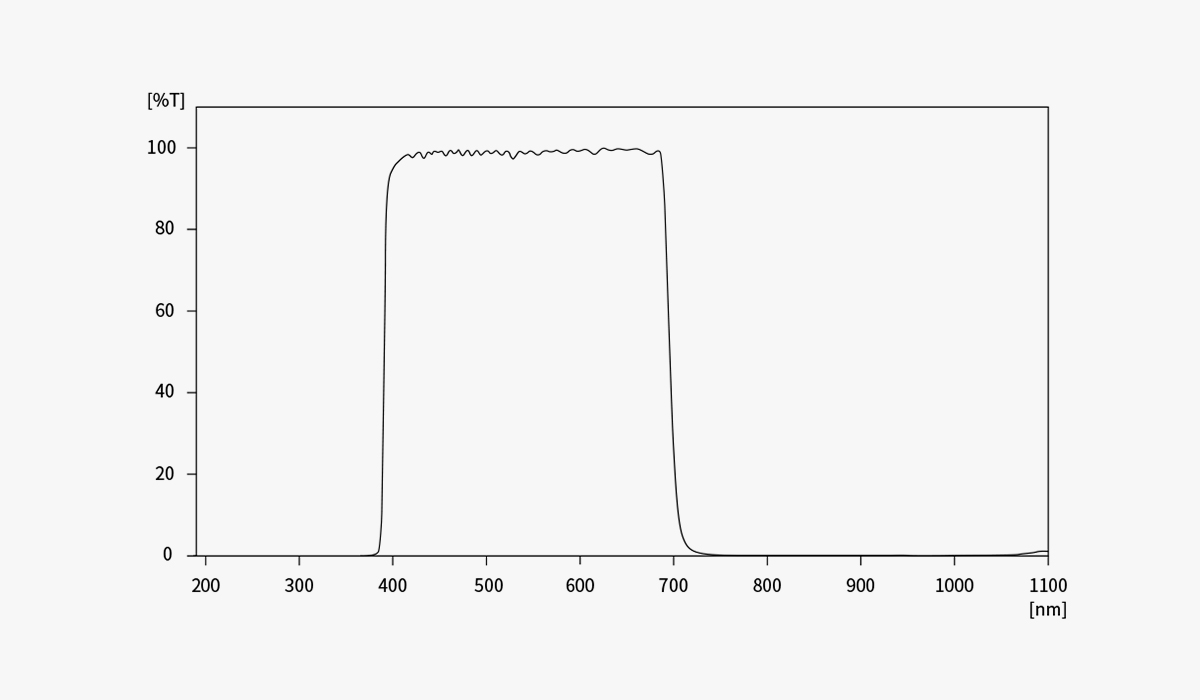
ZWO ASI2600MC Air IR cut coating

Frame Rate

The ASI2600MC Air is primarily a deep-sky camera rather than a planetary camera. Its APS-C sensor and cooling system are designed for long-exposure imaging, not high-speed planetary capture.

It can still be used for lunar and solar work with the right setup, but if your main interest is planets, a smaller high-frame-rate camera such as the ASI678MC may be more suitable.
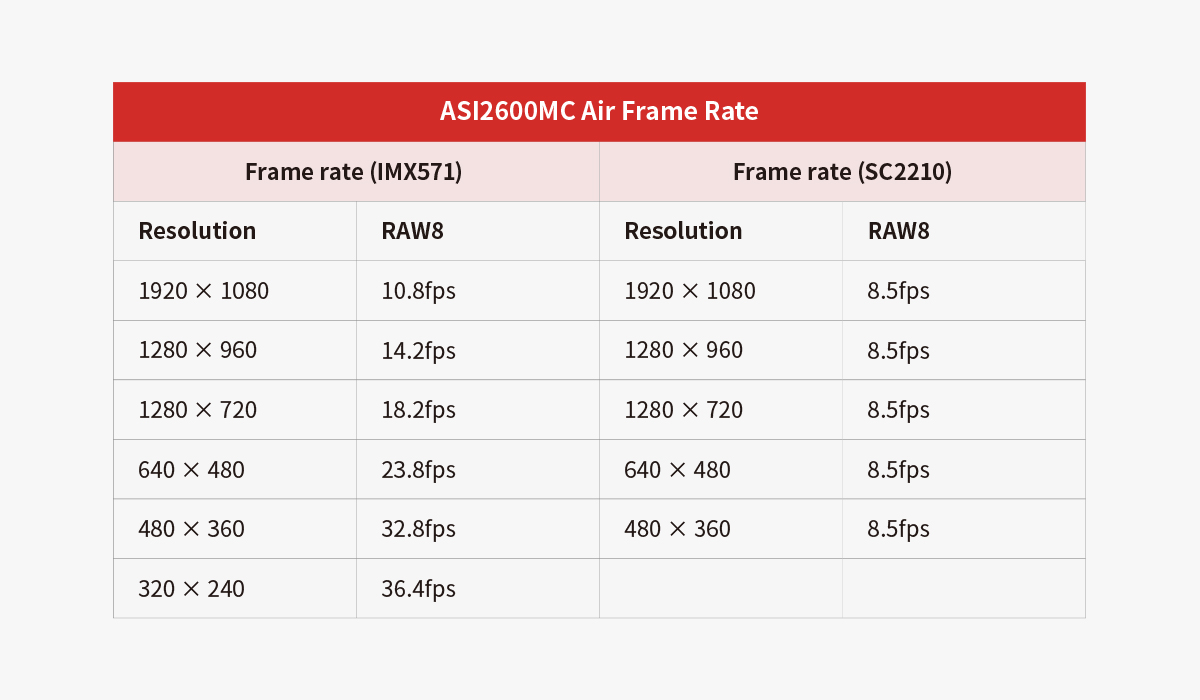
ZWO ASI2600MC Air frame rate chart

Camera Specification

The ASI2600MC Air specification places it firmly in the premium deep-sky imaging category. The combination of APS-C sensor size, 16-bit output, low read noise, TEC cooling and integrated smart control makes it one of the most complete colour astrophotography cameras currently available.
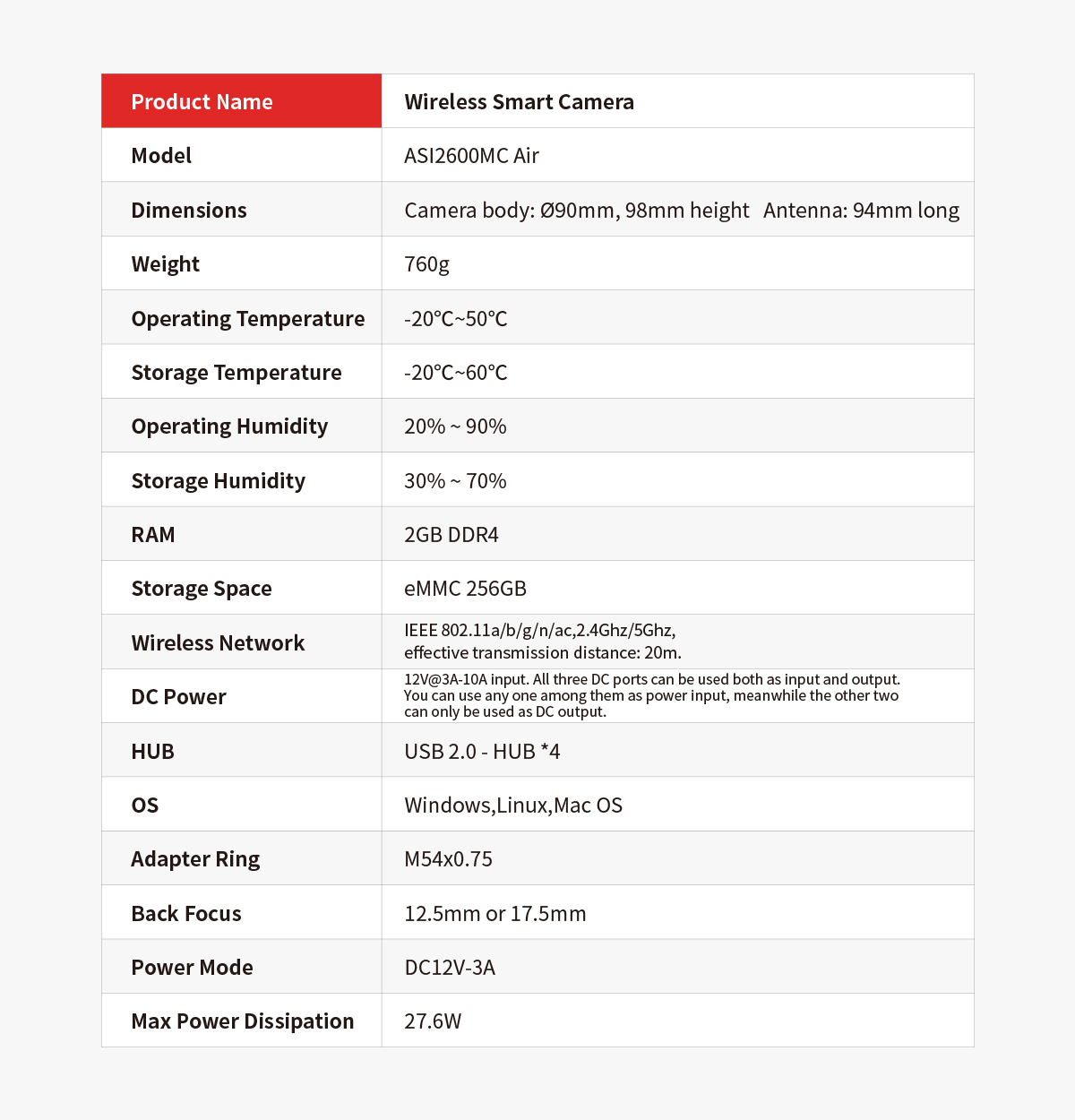
ZWO ASI2600MC Air camera specification chart

ZWO ASI2600MC Air full specification details

Camera Details

The physical design of the ASI2600MC Air is compact considering how much functionality is built into the camera body. This is particularly useful for portable rigs where size, weight and cable routing are important.
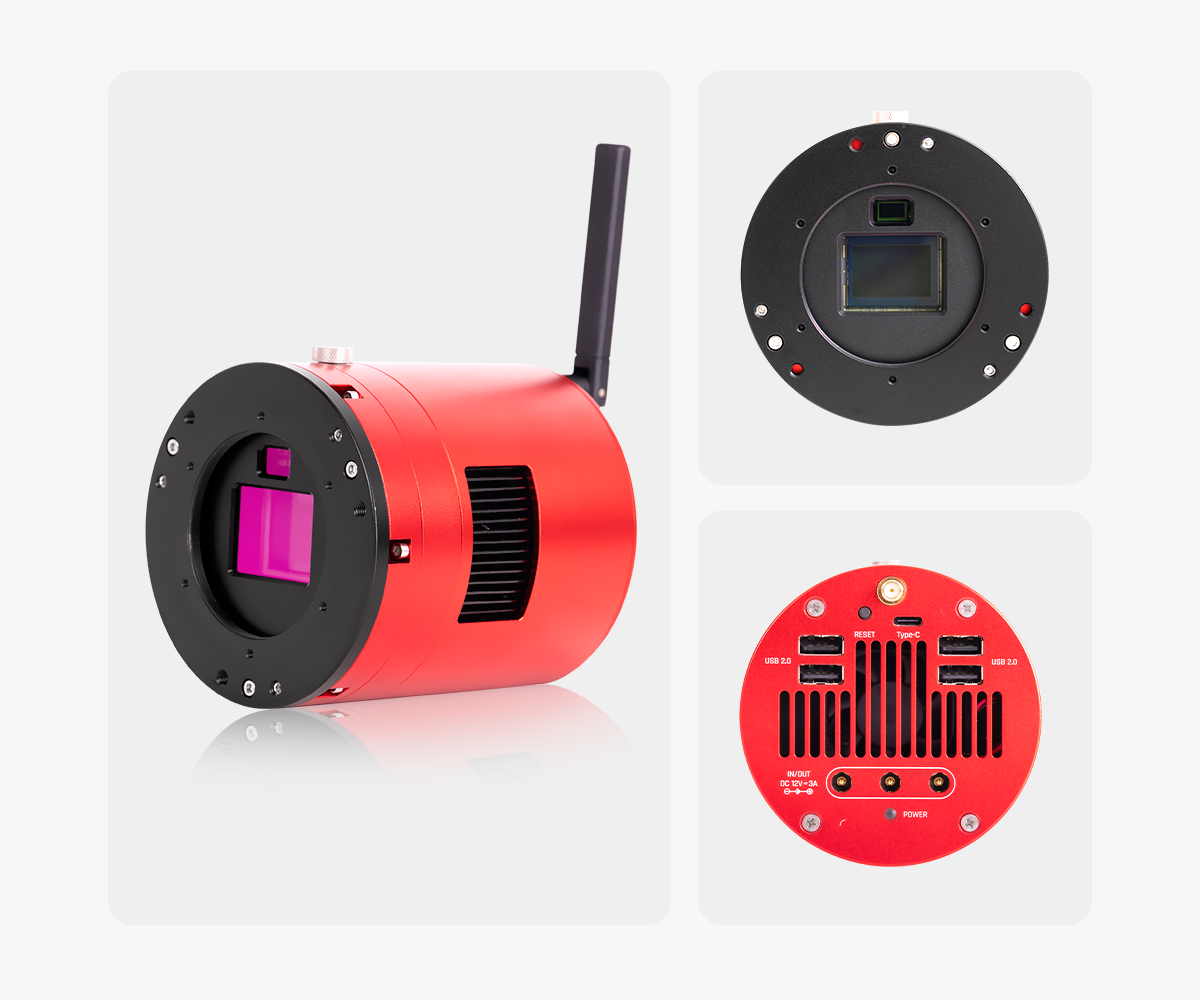
ZWO ASI2600MC Air camera body details

55mm Back Focus Solution

Many astrophotography telescopes, flatteners and reducers require a 55mm back focus distance. ZWO provides a practical spacing solution to help users achieve the correct distance from the sensor to the optical corrector.

Correct back focus is important. If spacing is wrong, stars may appear stretched or distorted toward the edges of the frame, especially with an APS-C sensor. Taking time to get this right will help the ASI2600MC Air perform at its best.
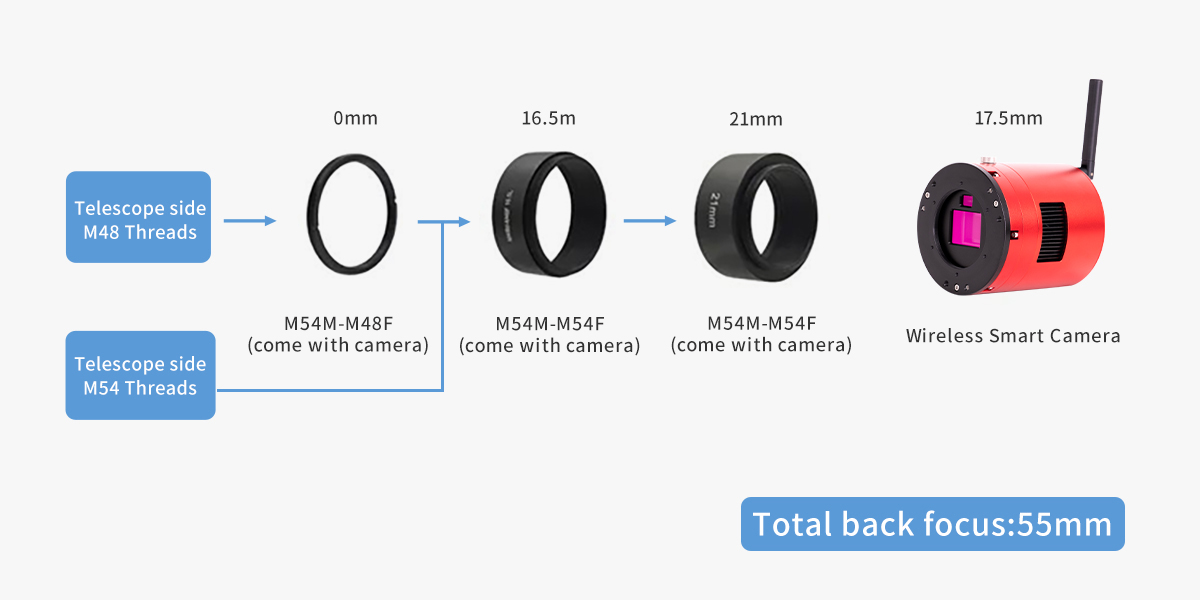
ZWO ASI2600MC Air 55mm back focus solution

Mechanical Diagram

The mechanical diagram is useful when planning adapters, spacing, reducers, flatteners and rotators. This is especially important for users building a complete imaging train around refractors or corrected astrographs.
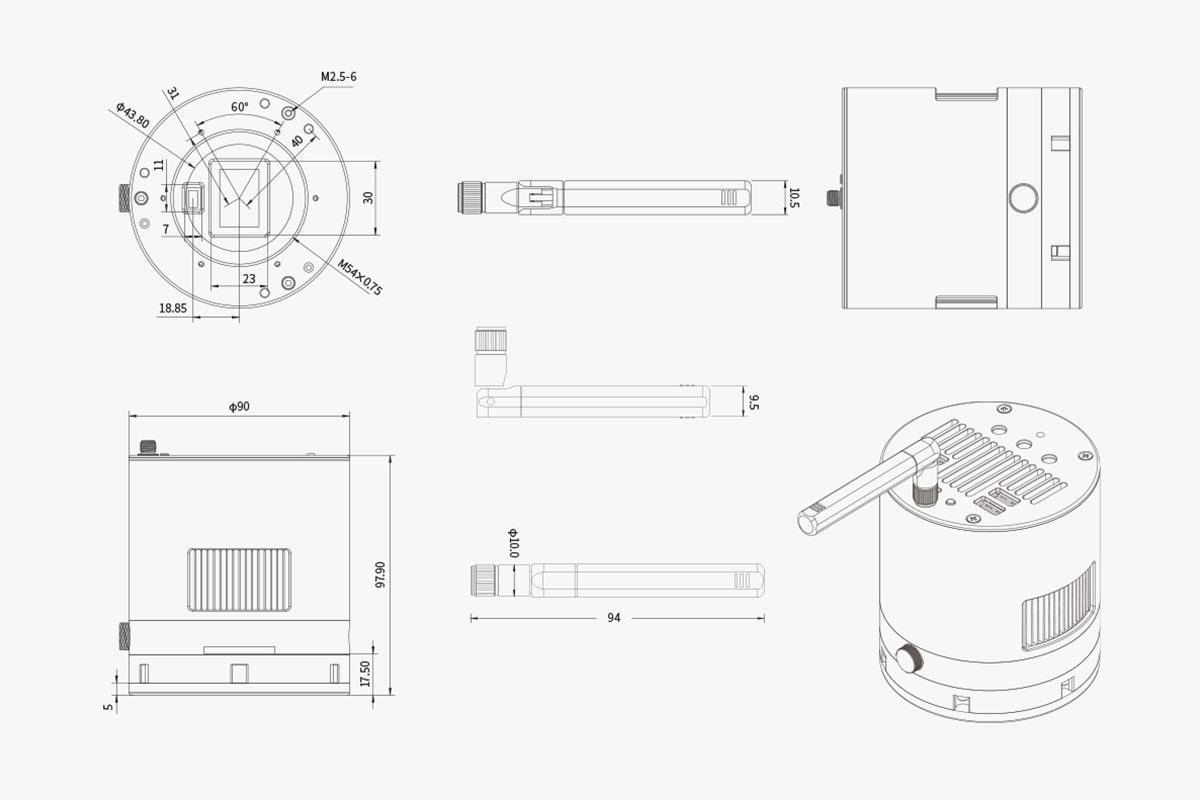
ZWO ASI2600MC Air mechanical diagram

What is in the Box?

The ASI2600MC Air includes the camera body and the required accessories shown below. Always check the current product listing for the latest package contents, as supplied accessories can vary by production batch or region.
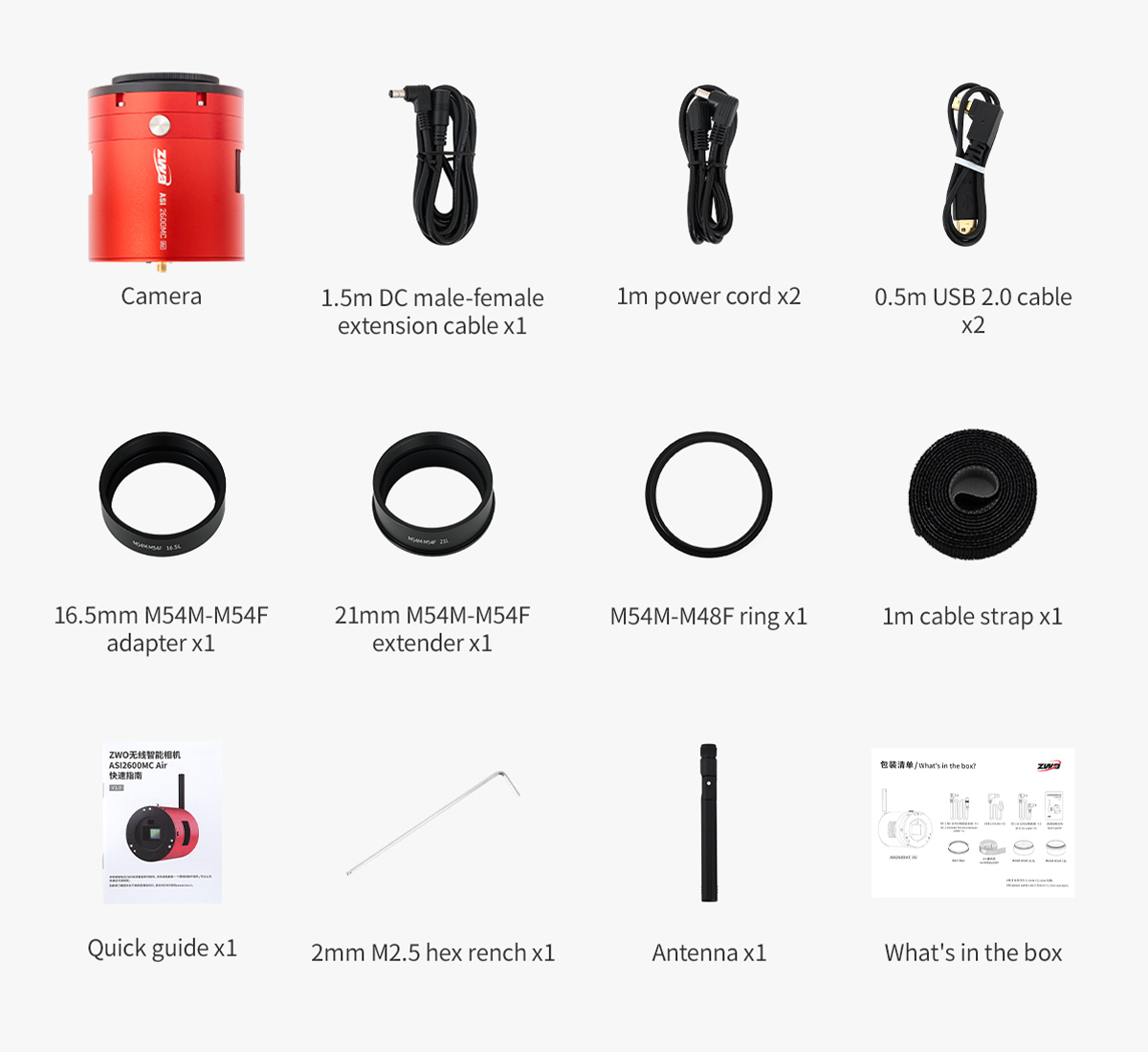
ZWO ASI2600MC Air box contents

Who Should Buy the ZWO ASI2600MC Air?

The ASI2600MC Air is ideal for astrophotographers who want a serious deep-sky camera but do not want a complicated, cable-heavy setup.

  • DSLR users upgrading to a cooled astronomy camera: The improvement in cooling, sensitivity and workflow is significant.
  • Seestar or smart telescope users wanting to go further: This is a major step into proper telescope-based deep-sky imaging.
  • Portable imagers: Fewer boxes and fewer cables make setup much easier.
  • ZWO AM3 and AM5 users: The camera fits naturally into a modern ZWO ecosystem.
  • Refractor owners: The APS-C sensor pairs beautifully with many wide-field and medium focal length refractors.
  • Experienced imagers wanting a cleaner rig: The image quality is proven, but the system is much neater.

Who Might Prefer Something Else?

No camera is perfect for everyone. The ASI2600MC Air is excellent, but there are situations where another model may be a better fit.

  • Mono narrowband specialists: Consider the ASI2600MM Pro or mono Air version if you want full LRGB and narrowband control.
  • Planetary imagers: A smaller high-speed planetary camera may be more suitable.
  • Budget beginners: The ASI533MC Pro may be a more affordable first cooled camera.
  • Users outside the ZWO ecosystem: If you prefer NINA, mini PCs and mixed-brand hardware, a traditional camera may suit you better.

Recommended Telescope Pairings

Telescope Why it works well
ZWO FF65 APO Excellent portable wide-field pairing with APS-C coverage.
ZWO FF107 APO A strong premium refractor pairing for larger nebulae and galaxies.
Askar SQA85 Superb wide-field astrograph option with a flat, corrected field.
Askar FRA500 Very versatile focal length for nebulae, galaxies and clusters.
Askar 107PHQ Excellent for users wanting a more serious refractor system.

Pros

  • Excellent Sony IMX571 APS-C sensor
  • Very strong deep-sky image quality
  • Built-in guide camera
  • Integrated ASIAIR control
  • Cleaner cable management
  • Internal storage
  • Dual-band Wi-Fi
  • Ideal for AM3 and AM5 setups
  • Great choice for portable imaging
  • Strong long-term upgrade path within the ZWO ecosystem

Considerations

  • Premium price compared with simpler cooled cameras
  • Best suited to users who like the ZWO ecosystem
  • Colour camera, not mono
  • Not primarily designed for planetary imaging
  • Long focal length users may still prefer separate guiding options

Frequently Asked Questions

Is the ZWO ASI2600MC Air good for beginners?

Yes, but it is a premium option. It is easier to use than many traditional deep-sky setups because ASIAIR control, guiding and connectivity are built in. However, complete beginners on a smaller budget may also consider the ASI533MC Pro.

Is the ASI2600MC Air better than the ASI2600MC Pro?

Image quality is based around the same excellent IMX571 sensor family, but the Air adds integrated ASIAIR control, a guide camera, storage and power management. The MC Pro may suit users who already have a separate control system.

Does the ASI2600MC Air need a separate guide camera?

For many refractor setups, no. It has a built-in SC2210 guide sensor. Some longer focal length systems may still benefit from an off-axis guider or separate guide solution.

Can I use the ASI2600MC Air with the ZWO AM3 or AM5?

Yes. It is an excellent match for both mounts and helps create a clean, portable imaging setup.

Is the ASI2600MC Air suitable for galaxies?

Yes. With the right telescope, it is very capable for galaxies. A medium focal length refractor or longer corrected telescope will give better image scale for smaller galaxies.

Is it good for nebulae?

Yes. The APS-C sensor is excellent for large nebulae, and the colour sensor works well with suitable dual-band filters under light-polluted skies.

Does it work without a laptop?

Yes. The ASIAIR App allows control from a phone or tablet, making laptop-free imaging possible.

Can I use it with NINA?

The ASI2600MC Air is primarily designed around the ASIAIR ecosystem, but ZWO states that third-party PC software can be supported through ASCOM Alpaca when the correct ASCOM requirements are met.

Is APS-C better than a smaller sensor?

APS-C gives a wider field of view than smaller sensors such as 1-inch or 4/3-inch formats. This is useful for large nebulae, star fields and framing flexibility.

What filters should I use?

For broadband imaging, a UV/IR or built-in IR-cut solution is suitable. For emission nebulae under light pollution, a dual-band filter is highly recommended.

Final Verdict

The ZWO ASI2600MC Air is one of the most complete one-shot colour astrophotography cameras currently available. It takes the proven image quality of the IMX571 APS-C sensor and combines it with the practical features astrophotographers actually need in the field: guiding, control, storage, power distribution and cleaner cabling.

For anyone building a premium portable deep-sky imaging system, especially around the ZWO AM3 or AM5, this camera is extremely easy to recommend. It is not the cheapest route into cooled astrophotography, but it is one of the neatest, most capable and most user-friendly solutions available.

If you want high-quality deep-sky images without building a complicated multi-box rig, the ASI2600MC Air is one of the strongest options in the ZWO range.


Considering the ZWO ASI2600MC Air?

The ASI2600MC Air is one of the most advanced one-shot colour astronomy cameras available, but the best choice always depends on your telescope, mount, targets and experience level.

Our ZWO camera buying guide compares the ASI2600MC Air with other popular models including the ASI2600MM Pro, ASI533MC Pro, ASI678MC and ASI174MM Mini.

Read the Ultimate ZWO Camera Buying Guide →

```

ZWO ASI2600MC Air – 26MP APS-C Sensor, Wi-Fi Astrophotography Camera
ZWO ASI 2600MC Air – 26MP APS-C Sensor, Wi-Fi Astrophotography Camera
Drawer Title
Similar Products