Skip to content
Skip to product information
Description

Dark Clear Skies · SVBONY SV220 · W9172C / W9172D

SV220 7nm SII & OIII

Add sulphur to your colour-camera nebula imaging.

Record sulphur-II and oxygen-III emission together, then combine your data with a separate H-alpha/OIII imaging session to build a three-channel SHO image. Choose the 1.25-inch or 2-inch mounted filter to suit your imaging train.

SII + OIIITwo nebula emission bands
7nmBandwidth per passband
≥88%Specified peak transmission
1.25″ / 2″Two mounted sizes

The SVBONY SV220 SII/OIII dual-band filter is designed for emission-line astrophotography with a one-shot-colour camera. Its two narrow transmission windows select blue-green OIII around 500.7nm and deep-red SII around 672nm, while suppressing much of the light outside those bands.

It is particularly useful if you already image through an H-alpha/OIII filter and want to capture a separate sulphur signal. That extra dataset gives you more control over nebula colour and the option to process your images in the SHO, or Hubble, palette.

SVBONY SV220 W9172D 2-inch filter with Duo-Band SII plus OIII 7nm lettering on the mounted cell
The 2-inch W9172D shown here uses an M48 × 0.75 mounting thread. Select the correct size for your filter holder before ordering. Manufacturer image.
  • Capture the sulphur your H-alpha/OIII filter leaves out. Acquire a dedicated SII-containing exposure set without changing to a monochrome camera.
  • Collect oxygen at the same time. Both SII and OIII pass through the filter during each exposure, making useful use of the colour sensor's red and blue/green response.
  • Suppress unwanted background light. The 7nm passbands and manufacturer-specified ≥OD5 out-of-band blocking help separate emission-line detail from surrounding sky glow.
  • Match the fitting to your equipment. Choose the 26mm clear aperture of W9172C or the larger 44mm opening of W9172D.

From two filters to an SHO image

SHO colour assigns SII to red, H-alpha to green and OIII to blue. The SII/OIII filter provides the sulphur and oxygen information; a separate H-alpha/OIII filter supplies the hydrogen information in another exposure set.

Capture stage Filter and useful data
1 · Hydrogen and oxygen Capture your target through an H-alpha/OIII filter, such as the SV220 7nm H-alpha/OIII.
2 · Sulphur and oxygen Replace it with this SV220 SII/OIII filter and capture another exposure set with matching framing.
3 · Process and combine Calibrate and align the datasets, extract the appropriate channel information and combine SII, H-alpha and OIII into the chosen colour palette.

Use the filters one at a time

Take separate exposure sets through the two filters. Physically stacking an H-alpha/OIII filter with an SII/OIII filter does not create a three-band filter: each would reject wavelengths the other is intended to pass. A complete SHO image also needs suitable processing; it is not produced automatically by one exposure.

Sulphur strength varies between targets and can be faint. Plan the integration time around the quality of each dataset rather than assuming every channel needs the same exposure time. Refocus and take suitable flat frames after changing filters.

What the 7nm passbands do

FWHM, or full width at half maximum, describes a transmission band's width at half its peak. Each of this filter's two bands has a nominal 7nm FWHM. The filter selects useful emission wavelengths instead of passing the whole visible spectrum.

SVBONY transmission graph for the 2-inch SV220 7nm SII and OIII filter showing peaks near 500.7nm and 672nm
SVBONY's transmission illustration for W9172D shows the two narrow windows within the specified 300–1000nm wavelength range. It is a manufacturer reference graph, not an individual test certificate. Select the image for a larger view.

The specified ≥88% peak transmission concerns the useful passbands. The ≥OD5 blocking concerns wavelengths outside those windows. The filter improves contrast by rejecting unwanted light; it does not increase the amount of nebula light reaching the telescope.

Light pollution and moonlight still affect the result

Light within the transmitted bands can still reach the sensor. A narrowband filter can make emission-nebula imaging more productive under bright skies, while a darker sky, careful target choice and sufficient integration time remain valuable.

Choose the size for your complete imaging train

The two sizes transmit the same emission bands, but their mechanical fittings and clear openings differ. Match the filter thread and cell clearance to your drawer, wheel or holder, then check the opening required by your sensor and light cone.

1.25-inch · W9172C

M28.5 × 0.6 thread · 26mm clear aperture. Choose it for a compatible 1.25-inch mounted-filter holder where the clear opening suits your camera and filter-to-sensor distance.

2-inch · W9172D

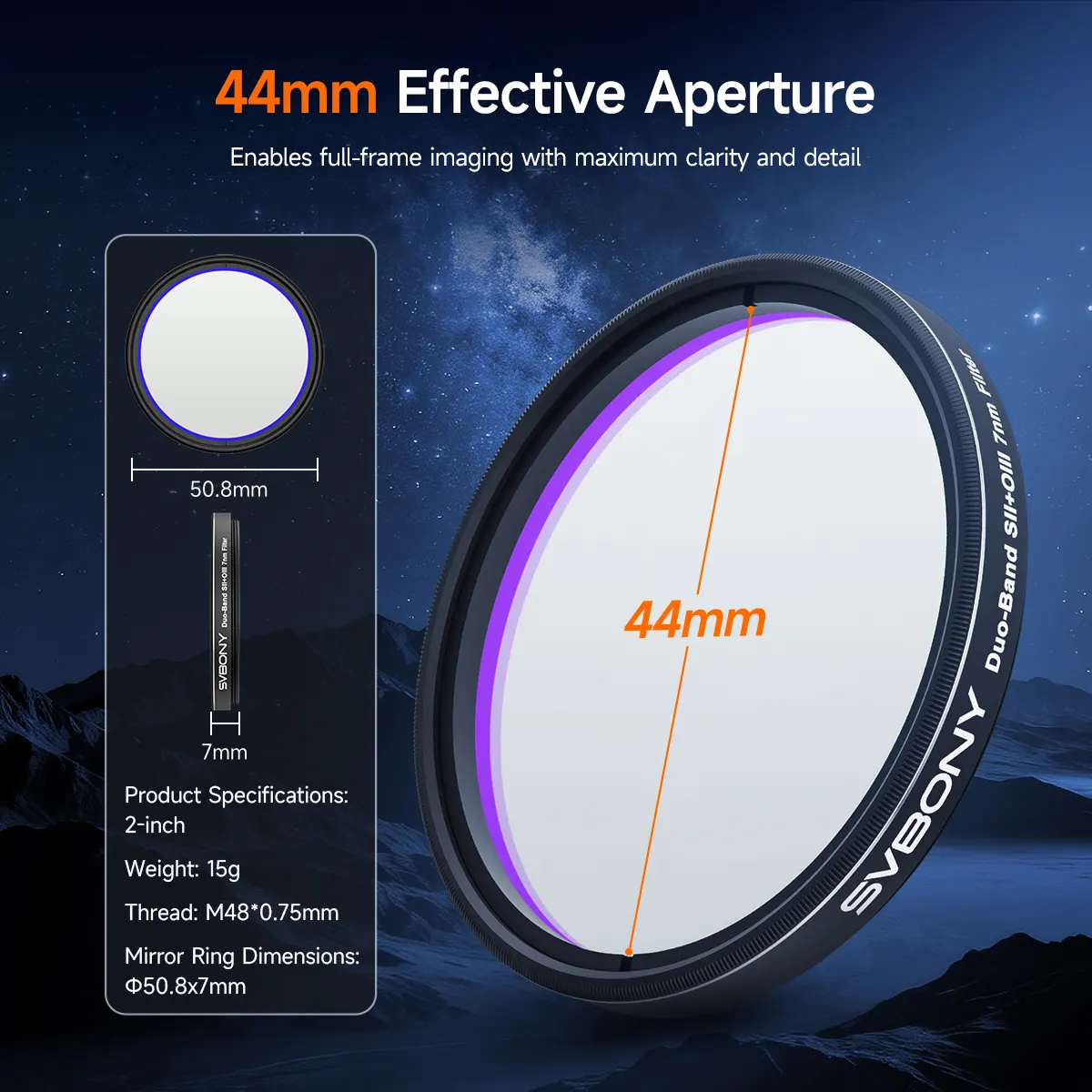
M48 × 0.75 thread · 44mm clear aperture. Choose it for a compatible 2-inch mounted-filter holder when the imaging train needs the larger opening.

SVBONY’s W9172D drawing specifies a 50.8mm cell diameter and 7mm overall height. Check the holder’s clearance as well as its M48 × 0.75 mounting thread before ordering.

SVBONY SV220 W9172C 1.25-inch 7nm SII and OIII mounted filter
The smaller W9172C has its own 1.25-inch fitting. It is a size choice on this listing, with a separate SKU from the 2-inch W9172D. Manufacturer image.
SVBONY W9172D 2-inch SII and OIII filter drawing showing a 50.8mm cell diameter, 7mm overall height, M48 by 0.75 thread and 44mm clear aperture
W9172D dimensions and clear aperture, shown in SVBONY’s manufacturer drawing. Full-frame coverage depends on the complete imaging train; the filter size alone does not guarantee it.

A 2-inch filter does not guarantee unvignetted full-frame coverage. Sensor dimensions, the distance from filter to sensor, focal ratio and other restrictions in the light path all matter. A camera's M42 or M48 connection is also distinct from the filter mounting thread inside its holder.

Camera, telescope and target suitability

One-shot-colour astronomy cameras: this is the intended application. The camera records both transmitted bands at once, and appropriate colour-channel processing is needed to make use of the sulphur and oxygen information.

Monochrome cameras: one exposure records the combined light from both bands as a greyscale image. Use separate single-band filters if you need independently isolated SII and OIII datasets on a mono sensor.

DSLR and mirrorless cameras: check both the mounting arrangement and the camera's sensitivity around the deep-red SII band. An internal camera filter may attenuate that signal.

Fast optics need an individual check

Interference-filter passbands can shift as the incoming light angle changes. Tell us the telescope, reducer and working focal ratio before ordering for a very fast system. Physical fit alone does not establish optical suitability, and this filter should not be assumed compatible with an f/2 RASA or HyperStar setup.

Emission-line subjects

Use it for emission nebulae, planetary nebulae and supernova remnants with useful SII and/or OIII emission. The relative strength of those signals varies across objects and structures.

Broadband subjects

Galaxies, reflection nebulae and star clusters emit much of their light outside these narrow windows. Use a suitable broadband approach when the aim is to capture their continuum light and natural star colours.

Technical specifications

Specification 1.25-inch · W9172C 2-inch · W9172D
Manufacturer / model SVBONY / SV220 SVBONY / SV220
Filter type SII/OIII dual-band imaging filter SII/OIII dual-band imaging filter
Nominal band centres OIII 500.7nm; SII approximately 672nm OIII 500.7nm; SII approximately 672nm
FWHM per passband 7nm 7nm
Peak transmission ≥88% ≥88%
Specified wavelength range 300–1000nm 300–1000nm
Out-of-band blocking ≥OD5 ≥OD5
Clear aperture 26mm 44mm
Mounting thread M28.5 × 0.6; single thread M48 × 0.75; single thread
Substrate thickness 1.80mm 1.85mm
Surface quality 60/40 60/40
Manufacturer-listed net weight 7g 15–20g

Figures are manufacturer specifications. Substrate thickness is the glass thickness, not the total cell height or the spacing added by a complete filter holder. The wavelength range is not a continuous passband: light is intended to pass through the two narrow windows.

What you are ordering

One mounted SVBONY SV220 7nm SII/OIII filter in the selected size: W9172C for 1.25-inch or W9172D for 2-inch.

A separate H-alpha/OIII filter, camera, telescope, filter holder and any adapters are additional items. The size choices on this page are individual filters, not a two-filter SHO set.

Questions before you buy

Is this the same as the SV220 H-alpha/OIII filter?

It records different red-band information. W9172C and W9172D transmit SII and OIII. W9172A and W9172B are the 7nm H-alpha/OIII versions; W9198A and W9198B are the 3nm H-alpha/OIII versions. Check the SKU, bands and diameter together.

Can I create an SHO image with this filter alone?

This filter records sulphur and oxygen. Full SHO also requires separately acquired H-alpha information and processing to combine the channels. A separate H-alpha/OIII filter is a practical companion for a colour-camera workflow.

Can I use it with an existing 3nm H-alpha/OIII filter?

The two filters can collect complementary datasets in separate exposure sets, provided each is suitable for the optical system. Their bandwidths, backgrounds and transmission differ, so process and balance the datasets individually instead of assuming identical signal levels.

Will I need to refocus?

Check focus after changing filters. Glass thickness and the rest of the optical train affect the focus position. Follow the telescope or corrector manufacturer's spacing guidance and capture calibration frames appropriate to each filter arrangement.

Does the filter guarantee halo-free stars?

No. Reflections and halos depend on the filter, camera window, bright stars and other optical surfaces. Check your own imaging train rather than assuming any filter will eliminate every reflection.

Build the right filter pairing for your camera

Tell us your telescope, reducer, camera and filter holder. Dark Clear Skies can help you choose the diameter and check how this SII/OIII filter fits into your imaging workflow.

Ask DCS about your setup
Dark Clear Skies · Passion for the Night Sky, Delivered.

SVBONY SV220 7nm SII & OIII Dual-Band Filter – 1.25″ or 2″

Regular price £149.99
Or £49.99 × 3 interest-free with PayPal

W9172D

  • 2"
  • 1.25"

Dark Clear Skies · SVBONY SV220 · W9172C / W9172D

SV220 7nm SII & OIII

Add sulphur to your colour-camera nebula imaging.

Record sulphur-II and oxygen-III emission together, then combine your data with a separate H-alpha/OIII imaging session to build a three-channel SHO image. Choose the 1.25-inch or 2-inch mounted filter to suit your imaging train.

SII + OIIITwo nebula emission bands
7nmBandwidth per passband
≥88%Specified peak transmission
1.25″ / 2″Two mounted sizes

The SVBONY SV220 SII/OIII dual-band filter is designed for emission-line astrophotography with a one-shot-colour camera. Its two narrow transmission windows select blue-green OIII around 500.7nm and deep-red SII around 672nm, while suppressing much of the light outside those bands.

It is particularly useful if you already image through an H-alpha/OIII filter and want to capture a separate sulphur signal. That extra dataset gives you more control over nebula colour and the option to process your images in the SHO, or Hubble, palette.

SVBONY SV220 W9172D 2-inch filter with Duo-Band SII plus OIII 7nm lettering on the mounted cell
The 2-inch W9172D shown here uses an M48 × 0.75 mounting thread. Select the correct size for your filter holder before ordering. Manufacturer image.
  • Capture the sulphur your H-alpha/OIII filter leaves out. Acquire a dedicated SII-containing exposure set without changing to a monochrome camera.
  • Collect oxygen at the same time. Both SII and OIII pass through the filter during each exposure, making useful use of the colour sensor's red and blue/green response.
  • Suppress unwanted background light. The 7nm passbands and manufacturer-specified ≥OD5 out-of-band blocking help separate emission-line detail from surrounding sky glow.
  • Match the fitting to your equipment. Choose the 26mm clear aperture of W9172C or the larger 44mm opening of W9172D.

From two filters to an SHO image

SHO colour assigns SII to red, H-alpha to green and OIII to blue. The SII/OIII filter provides the sulphur and oxygen information; a separate H-alpha/OIII filter supplies the hydrogen information in another exposure set.

Capture stage Filter and useful data
1 · Hydrogen and oxygen Capture your target through an H-alpha/OIII filter, such as the SV220 7nm H-alpha/OIII.
2 · Sulphur and oxygen Replace it with this SV220 SII/OIII filter and capture another exposure set with matching framing.
3 · Process and combine Calibrate and align the datasets, extract the appropriate channel information and combine SII, H-alpha and OIII into the chosen colour palette.

Use the filters one at a time

Take separate exposure sets through the two filters. Physically stacking an H-alpha/OIII filter with an SII/OIII filter does not create a three-band filter: each would reject wavelengths the other is intended to pass. A complete SHO image also needs suitable processing; it is not produced automatically by one exposure.

Sulphur strength varies between targets and can be faint. Plan the integration time around the quality of each dataset rather than assuming every channel needs the same exposure time. Refocus and take suitable flat frames after changing filters.

What the 7nm passbands do

FWHM, or full width at half maximum, describes a transmission band's width at half its peak. Each of this filter's two bands has a nominal 7nm FWHM. The filter selects useful emission wavelengths instead of passing the whole visible spectrum.

SVBONY transmission graph for the 2-inch SV220 7nm SII and OIII filter showing peaks near 500.7nm and 672nm
SVBONY's transmission illustration for W9172D shows the two narrow windows within the specified 300–1000nm wavelength range. It is a manufacturer reference graph, not an individual test certificate. Select the image for a larger view.

The specified ≥88% peak transmission concerns the useful passbands. The ≥OD5 blocking concerns wavelengths outside those windows. The filter improves contrast by rejecting unwanted light; it does not increase the amount of nebula light reaching the telescope.

Light pollution and moonlight still affect the result

Light within the transmitted bands can still reach the sensor. A narrowband filter can make emission-nebula imaging more productive under bright skies, while a darker sky, careful target choice and sufficient integration time remain valuable.

Choose the size for your complete imaging train

The two sizes transmit the same emission bands, but their mechanical fittings and clear openings differ. Match the filter thread and cell clearance to your drawer, wheel or holder, then check the opening required by your sensor and light cone.

1.25-inch · W9172C

M28.5 × 0.6 thread · 26mm clear aperture. Choose it for a compatible 1.25-inch mounted-filter holder where the clear opening suits your camera and filter-to-sensor distance.

2-inch · W9172D

M48 × 0.75 thread · 44mm clear aperture. Choose it for a compatible 2-inch mounted-filter holder when the imaging train needs the larger opening.

SVBONY’s W9172D drawing specifies a 50.8mm cell diameter and 7mm overall height. Check the holder’s clearance as well as its M48 × 0.75 mounting thread before ordering.

SVBONY SV220 W9172C 1.25-inch 7nm SII and OIII mounted filter
The smaller W9172C has its own 1.25-inch fitting. It is a size choice on this listing, with a separate SKU from the 2-inch W9172D. Manufacturer image.
SVBONY W9172D 2-inch SII and OIII filter drawing showing a 50.8mm cell diameter, 7mm overall height, M48 by 0.75 thread and 44mm clear aperture
W9172D dimensions and clear aperture, shown in SVBONY’s manufacturer drawing. Full-frame coverage depends on the complete imaging train; the filter size alone does not guarantee it.

A 2-inch filter does not guarantee unvignetted full-frame coverage. Sensor dimensions, the distance from filter to sensor, focal ratio and other restrictions in the light path all matter. A camera's M42 or M48 connection is also distinct from the filter mounting thread inside its holder.

Camera, telescope and target suitability

One-shot-colour astronomy cameras: this is the intended application. The camera records both transmitted bands at once, and appropriate colour-channel processing is needed to make use of the sulphur and oxygen information.

Monochrome cameras: one exposure records the combined light from both bands as a greyscale image. Use separate single-band filters if you need independently isolated SII and OIII datasets on a mono sensor.

DSLR and mirrorless cameras: check both the mounting arrangement and the camera's sensitivity around the deep-red SII band. An internal camera filter may attenuate that signal.

Fast optics need an individual check

Interference-filter passbands can shift as the incoming light angle changes. Tell us the telescope, reducer and working focal ratio before ordering for a very fast system. Physical fit alone does not establish optical suitability, and this filter should not be assumed compatible with an f/2 RASA or HyperStar setup.

Emission-line subjects

Use it for emission nebulae, planetary nebulae and supernova remnants with useful SII and/or OIII emission. The relative strength of those signals varies across objects and structures.

Broadband subjects

Galaxies, reflection nebulae and star clusters emit much of their light outside these narrow windows. Use a suitable broadband approach when the aim is to capture their continuum light and natural star colours.

Technical specifications

Specification 1.25-inch · W9172C 2-inch · W9172D
Manufacturer / model SVBONY / SV220 SVBONY / SV220
Filter type SII/OIII dual-band imaging filter SII/OIII dual-band imaging filter
Nominal band centres OIII 500.7nm; SII approximately 672nm OIII 500.7nm; SII approximately 672nm
FWHM per passband 7nm 7nm
Peak transmission ≥88% ≥88%
Specified wavelength range 300–1000nm 300–1000nm
Out-of-band blocking ≥OD5 ≥OD5
Clear aperture 26mm 44mm
Mounting thread M28.5 × 0.6; single thread M48 × 0.75; single thread
Substrate thickness 1.80mm 1.85mm
Surface quality 60/40 60/40
Manufacturer-listed net weight 7g 15–20g

Figures are manufacturer specifications. Substrate thickness is the glass thickness, not the total cell height or the spacing added by a complete filter holder. The wavelength range is not a continuous passband: light is intended to pass through the two narrow windows.

What you are ordering

One mounted SVBONY SV220 7nm SII/OIII filter in the selected size: W9172C for 1.25-inch or W9172D for 2-inch.

A separate H-alpha/OIII filter, camera, telescope, filter holder and any adapters are additional items. The size choices on this page are individual filters, not a two-filter SHO set.

Questions before you buy

Is this the same as the SV220 H-alpha/OIII filter?

It records different red-band information. W9172C and W9172D transmit SII and OIII. W9172A and W9172B are the 7nm H-alpha/OIII versions; W9198A and W9198B are the 3nm H-alpha/OIII versions. Check the SKU, bands and diameter together.

Can I create an SHO image with this filter alone?

This filter records sulphur and oxygen. Full SHO also requires separately acquired H-alpha information and processing to combine the channels. A separate H-alpha/OIII filter is a practical companion for a colour-camera workflow.

Can I use it with an existing 3nm H-alpha/OIII filter?

The two filters can collect complementary datasets in separate exposure sets, provided each is suitable for the optical system. Their bandwidths, backgrounds and transmission differ, so process and balance the datasets individually instead of assuming identical signal levels.

Will I need to refocus?

Check focus after changing filters. Glass thickness and the rest of the optical train affect the focus position. Follow the telescope or corrector manufacturer's spacing guidance and capture calibration frames appropriate to each filter arrangement.

Does the filter guarantee halo-free stars?

No. Reflections and halos depend on the filter, camera window, bright stars and other optical surfaces. Check your own imaging train rather than assuming any filter will eliminate every reflection.

Build the right filter pairing for your camera

Tell us your telescope, reducer, camera and filter holder. Dark Clear Skies can help you choose the diameter and check how this SII/OIII filter fits into your imaging workflow.

Ask DCS about your setup
Dark Clear Skies · Passion for the Night Sky, Delivered.
SVBONY SV220 W9172D 2-inch mounted 7nm SII and OIII dual-band filter
SVBONY SV220 7nm SII & OIII Dual-Band Filter – 1.25″ or 2″

Pairs well with

Drawer Title
Similar Products